What does Enid Blyton have to do with the history of adoption?
Many adoptees of a certain age remember the illustrated children’s book Mr. Fairweather and His Family (London: Bodley Head, 1960), written by journalist-turned-adoption-professional Margaret Kornitzer. But did you know that Enid Blyton had also written a children’s story about adoption? The prolific, popular—and controversial—author’s short story “The Child Who Was Chosen” was subtitled “a tale for adoptive parents to tell their adopted children, so that they may know how and why they were chosen.”
It appears to have been privately published and printed in 1955, perhaps as one of the author’s charitable efforts to help children, and may have been reproduced, or at least distributed, by the Standing Conference of Societies Registered for Adoption (the organisation of adoption agencies that later became the British Association for Adoption and Fostering/BAAF). I first saw it in the London County Council records in the London Archives, in a folder with two other leaflets produced for distribution to prospective adopters and adopters (one of which is dated 1961).
It also found its way to courts—a copy is held in the Northumberland archives—and newspaper advice columnists, one of whom was also a magistrate.
In 1955 Jane Dawson of the Manchester Evening News recommended the story to a reader concerned about her friend’s adopted son. The adoptive mother had asked her friend to tell him he was adopted, because she couldn’t “get herself to bring the words out.” Jane Dawson counseled against the mother outsourcing this conversation (“It should not be shirked, however hard it is”) and recommended the friend read “The Child Who Was Chosen.”
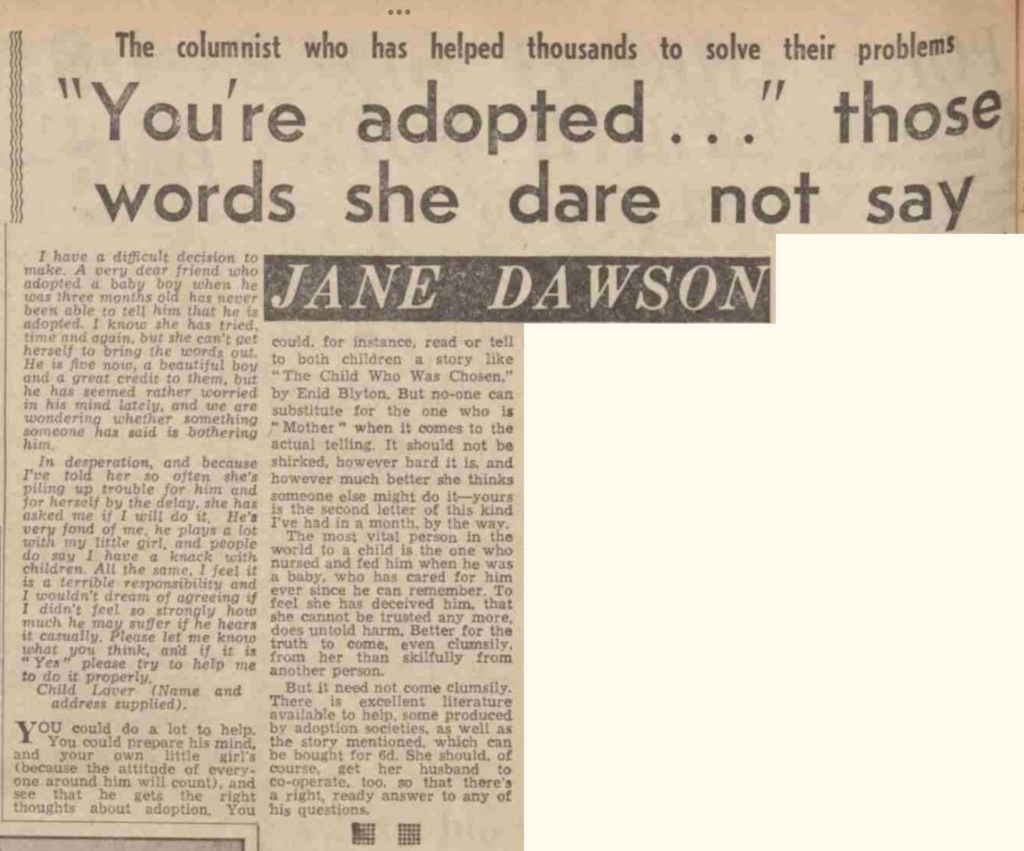
(Manchester Evening News, Friday, May 13th, 1955, p. 4)
In 1964 the columnist was still recommending the story, this time in response to a reader letter about her four-year-old adoptee. The child had found out she was adopted from a neighbour, taunting her by saying she had another mother who “didn’t want her” and that her parents would “send her back” if she wasn’t a “good girl.” Understandably, the young girl was traumatised and frightened that her adoptive parents too would reject her.
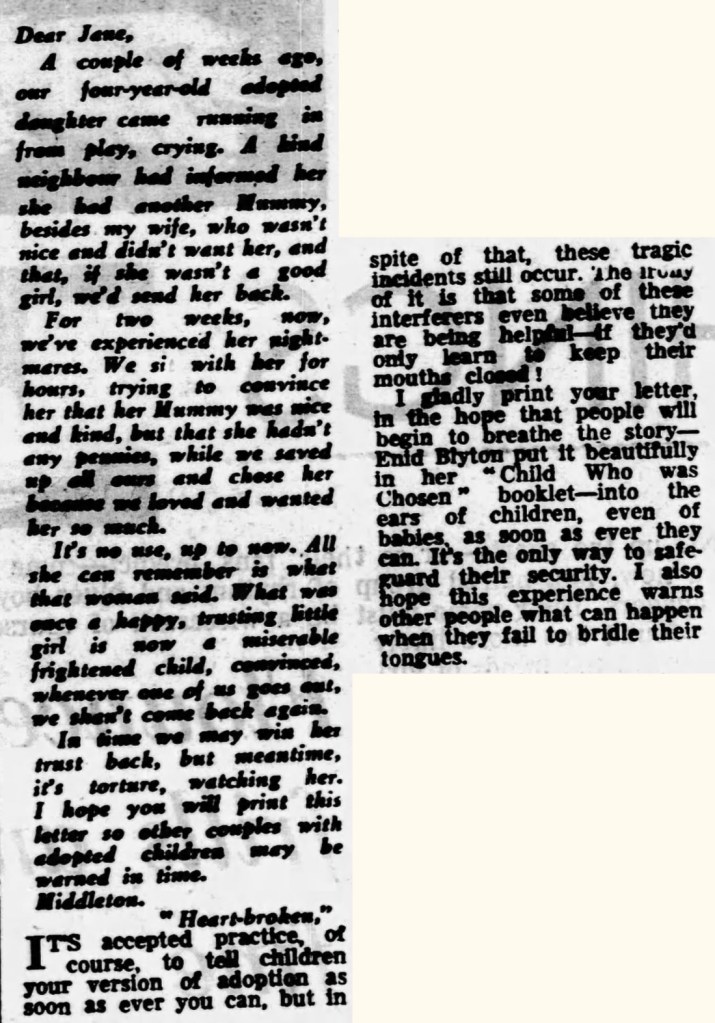
(Manchester Evening News, Friday, July 24th, 1964, p. 8)
Anne Allen, in her Parents’ Page column in the Sunday Pictorial, explained in 1961 that Cheshire magistrates, “faced with one or two tragic cases of children who have become bitter and anti-social when they found out the truth in their teens,” were handing the story out to adoptive parents. She argued that adopted children should be told when they are very small, laying out the consequences of late discovery: “For years [the adopted child] has felt secure, and then suddenly he is faced with the fact that his life has been built on a LIE. It is too late then to reassure him by telling him how much he was wanted in the first place.”
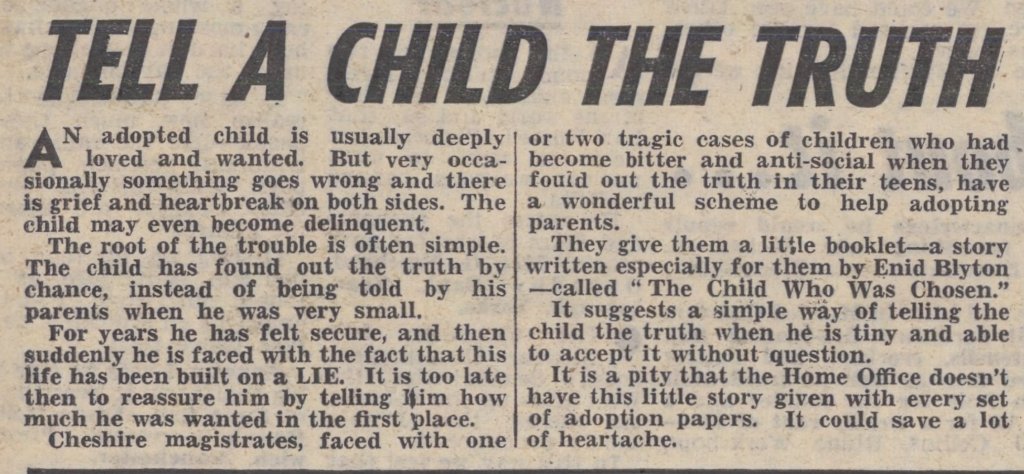
(Sunday Pictorial, March 5th, 1961, p. 23)
The following week, she wrote “I have had so many requests from the parents of adopted children for the booklet ‘The Child Who Was Chosen’ that there may be some delay in forwarding them—but be patient, your letters will be answered.”
Anne recommended it again in 1962, to M.B. in Canterbury, who knew they should tell their adopted daughter the truth “but I just can’t bring myself to do it.” At this time it was being produced by W.H. Smith and cost 10 pence.
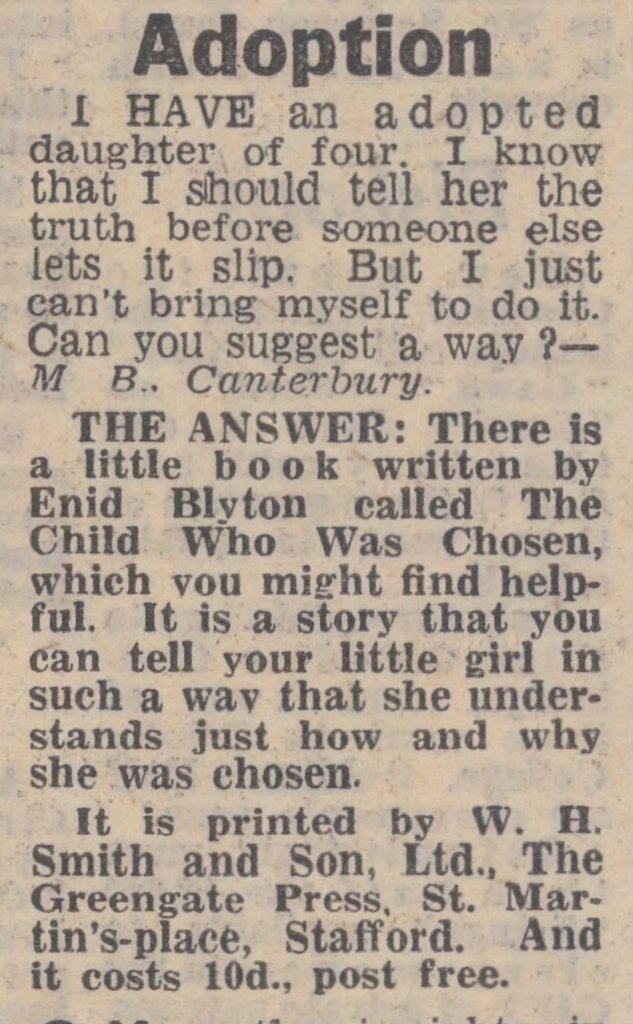
(Sunday Pictorial, July 8th, 1962, p. 20)
It is clear that there was a great deal of anxiety about when and how to tell your child they were adopted. And perhaps a reluctance, for why else would adoption professionals and others need to talk about how important it was? “Secrets and Lies” are built into adoption, and there is still no right for an adopted child to know they are adopted, nor for an older adopted adult to access our adoption files. Adoption professionals insisted it was right to tell a child, in an age-appropriate manner, that they were adopted, but it was never made law or official guidance. The autonomy of adopters once an adoption order has been made has always been given precedence over the rights, and in some cases welfare, of the adoptee. The trauma of discovery as an adolescent or as an adult compounds the pain and brings shock, betrayal, and confusion. But for some parents, it was easier to pretend than to tell the truth.
As for adoptees, we now view the narrative of Blyton’s story as harmful and many of us are sick of the “chosen” trope. Intended in part to make us feel better about ourselves—now why would we need that, if adoption is so great?—it has the actual effect of reinforcing the central, existential anxiety: if we’re loved, and lovable, why were we rejected? Why are we being asked to feel “grateful” and happy about our circumstances? How come they only adopted when they couldn’t have children “of their own”—what kind of a “choice” was that? And how can we make this new family like us, when we don’t even know how to like ourselves, so they too don’t reject us? The “chosen child” fallacy is usually the first cliché we are taught about ourselves. Some of us were even told we “chose” our adoptive parents—a kind of twisted new-age fantasy that couldn’t be farther from the truth. We had no choice at all. And the level of denial necessary to convince ourselves that “she loved you so much, she gave you away” is at the root of many adoptees’ mental health problems.
So it was with some glee that I found copies of “The Child Who Was Chosen” being sold off in bulk via small ads in 1970, for 21/- a dozen. By this time, Enid Blyton was falling out of favour—I clearly remember a primary school teacher in the 1970s telling my mother I shouldn’t be reading such rubbish—but the “chosen” line lives on, taking its place in the thought-stopping discourse of adoption, designed to prevent us all from questioning it.
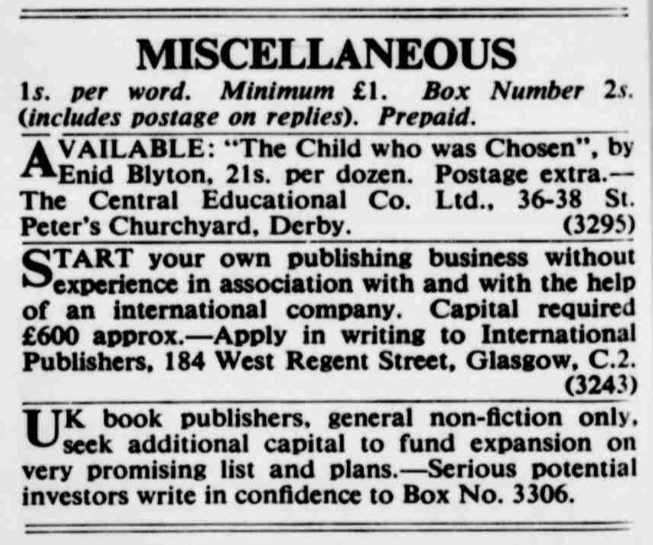
(The Bookseller, February 28th, 1970, p. 1554)
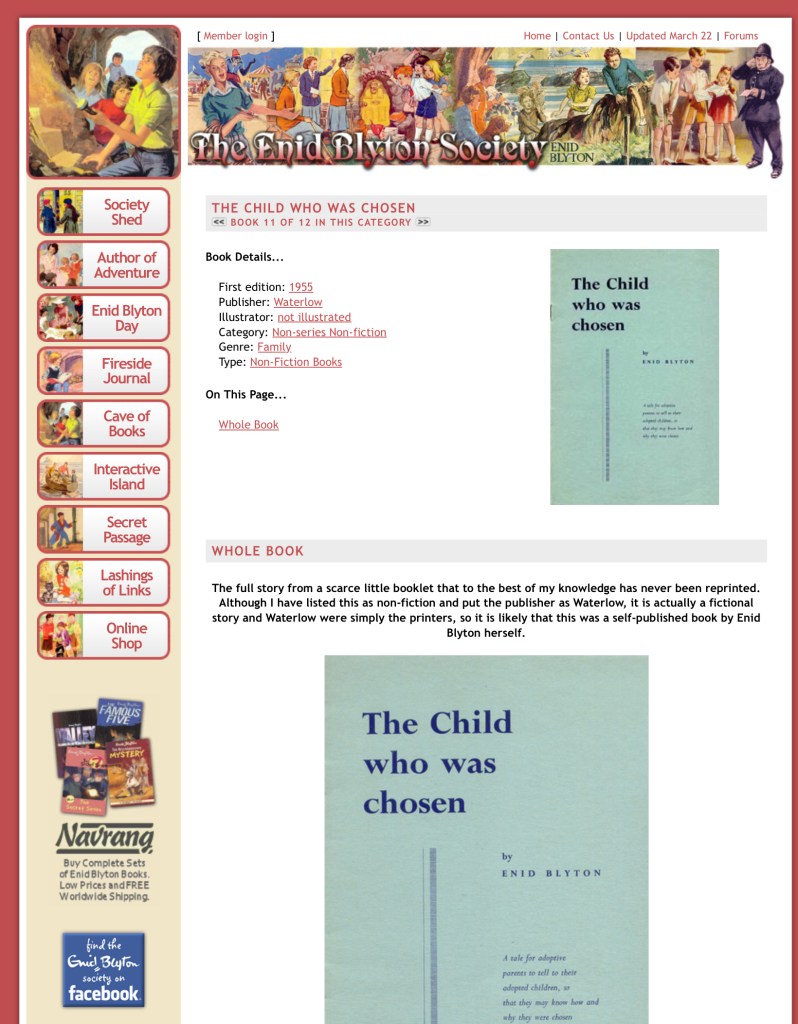
And the story itself? You can judge for yourself by reading the full text on the Enid Blyton Society website.
 Adoption History