TW: extreme ableism
Let us be clear that there was never a golden age of adoption in Britain. Adoption was, and is, transactional. Before the mass forced adoptions of the 1950s, 60s and 70s (for which there must be an accounting), a well-established system was in place to facilitate and encourage child adoption. Initially offering permanence only for the adopters—most adoption societies offered a ‘return at any time’ policy while making mothers sign their child over for life—once the first Adoption Act had been passed in 1926 and parental rights and responsibilities could be legally transferred, permanence worked both ways. And, of course, in adoption a child never had any agency, even on reaching adulthood.1
The reality of this permanency came as a shock to some adoptive parents. John Bull, an investigative publication with an interest in holding adoption societies to account, published an anonymous letter in its Humanist advice column in 1929, two years after the first adoption orders were issued in England. The correspondent and her husband had adopted a child some time before the Act was passed, later obtaining an adoption order from a judge to make their child’s adoption permanent and legally binding.2 Subsequently, their adopted child had been declared by a doctor to be ‘mentally defective’ and in need of long-term treatment and care.
The parents had written to the child’s mother to ask for financial support and received in return a solicitor’s letter reminding them that they had legally assumed all parental responsibility and warning them not to harass their client. “Am I, therefore,” writes the adoptive mother, “to submit and make myself responsible for the upkeep of this boy through what may be a long life-time, while the mother, in quite good circumstances, goes scot-free?” (Notice the language used—despite the adoption, she is not ‘the mother’ of her disabled child. Notice also the shift of blame to the biological mother: it is implied that she has done wrong and is getting away with it).
The answer: yes, yes you are responsible for this now. FAFO, 1929 edition.
A similar case (you can read it in full here) was reported by Elwin H.T. Nash, Medical Officer for Heston and Isleworth Urban District Council, in 1931.3 It had taken six years to resolve, and the adoptee in question was now 12. She had been adopted at the age of four from the National Children Adoption Association (NCAA) by “working-class parents of the very best type.” However, when their adopted daughter attended school for the first time the Medical Officer assessed her and determined she “would have to be certified as mentally defective.” When testing confirmed his ‘diagnosis’ the NCAA refused to take the girl back, citing their contract, which stipulated that a child could only be returned within the first month; adoption was not (they claimed) conditional upon their own medical adviser’s report proving correct. The Medical Officer then suggested that under consumer protection laws (the Food and Drugs Act), the contract was void because goods (a “normal child”) were not supplied as promised.
Under the 1926 Adoption Act it was clear-cut: full parental responsibility was permanently transferred by the effect of an adoption order. But this adoption had taken place prior to the new law and (unlike the first example above) had not subsequently been formalised by an adoption order. The Medical Officer conceded that cancellation of an order could lead the child to be taken into care by the Board of Guardians/Local Authority, but argued that there should be a loophole added to the Adoption Act to allow for such cases. In his opinion, parents who have their own children must take on all responsibility but those who adopt, if “mental deficiency” is later diagnosed that would have put them off adopting, should be given an option to cancel the adoption order.
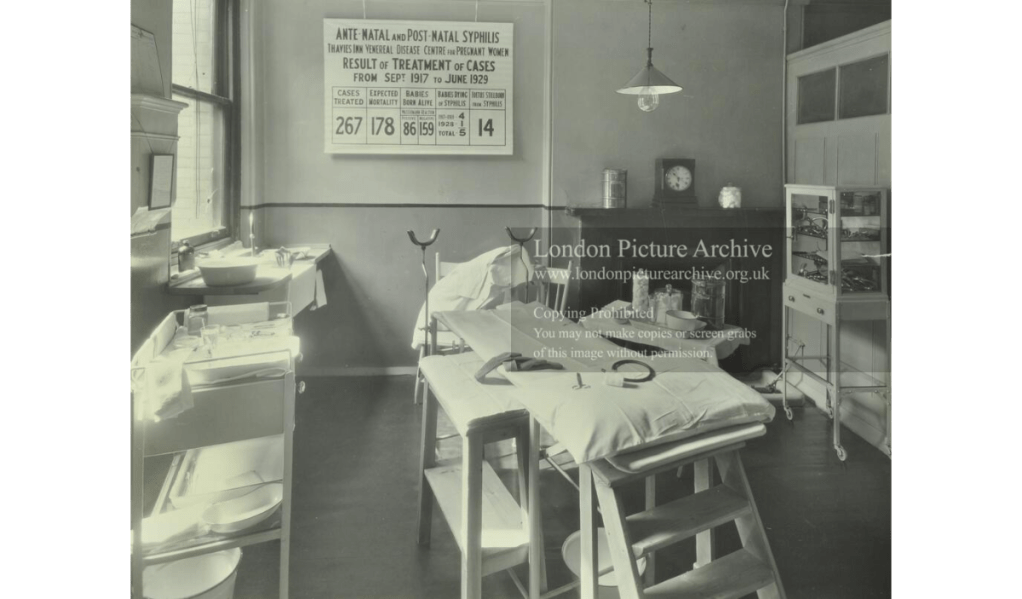
In this case, after a change of personnel the NCAA’s attitude softened, and they agreed that such an amendment to the Act would be beneficial (it was never made law). It was also discovered that the adopted girl had been born in Thavies Inn, “a Venereal Hospital for pregnant women” but this had not been disclosed to the adopters. Finally, the NCAA agreed to let the adopters out of their contract. (Odd, considering it was not legal to begin with to contractually transfer parental rights). The final outcome for the adoptee? “Eventually…the child was got away to a Home, under the Middlesex County Council, and the adopting parents freed from what had been latterly an intolerable burden [i.e., behavioural issues].”4
If this sounds familiar, it may be because we hear these days of adoption breakdowns or “disruptions”—cases in which a child proves too difficult for the adopters to handle (no matter how many ‘Non-Violent Resistance’ training courses they have attended, funded through the Adoption and Special Guardianship Support Fund). Adopters then seek to place their children in local authority care, though there is still no loophole and no way to get out of an adoption order.5 The charge these days is not one of ‘mental defect’—though FASD, a developmental disorder, is often cited as a contributing factor to behavioural challenges—but of children too traumatised by what they experienced in their pre-adoption lives to be safely and adequately parented. Perhaps, like the girl removed in the 1931 case, their adoptive child has “developed undesirable habits,…robbing them, and threatening the adoptive mother”?6 Still, at least they tried, right?


Accessed via the British Newspaper Archive.
- In England and Wales, adoptees did not have a right to their own birth records until 1975, and those adopted before 2005 still do not have a statutory right to see their own adoption records. Furthermore, no UK adoptee has the right to revoke their adoption as an adult. ↩︎
- John Bull, November 30, 1929, p.34. ↩︎
- Heston & Isleworth Urban District Education Committee (1932). Twenty-Fourth Annual Report of the School Medical Officer for the Year Ended 31st December, 1931. Attribution-NonCommercial 4.0 International (CC BY-NC 4.0). Source: Wellcome Collection. https://wellcomecollection.org/works/n2ja6ab4. The case in question is reported on pages 29 to 34. ↩︎
- Ibid., p.33. ↩︎
- Recent examples include: Eleanor Bradford, at the time a trustee of Adoption UK; Karen Maguire who even received compensation in an out-of-court settlement; and others interviewed for this article. ↩︎
- Twenty-Fourth Annual Report, p. 32. ↩︎
 Adoption History