Getting used to the new-fangled adoption certificates
The first adoption orders were issued in England and Wales in 1927. Some adoptive parents of older children applied immediately to the courts to legalise the adoption of their children, so it was not long before adoptees were applying for jobs, including civil service roles, and using the new adoption certificates as proof of their name and age. It appears that at this time, the place of birth was not included on the adoption certificates as it is today.
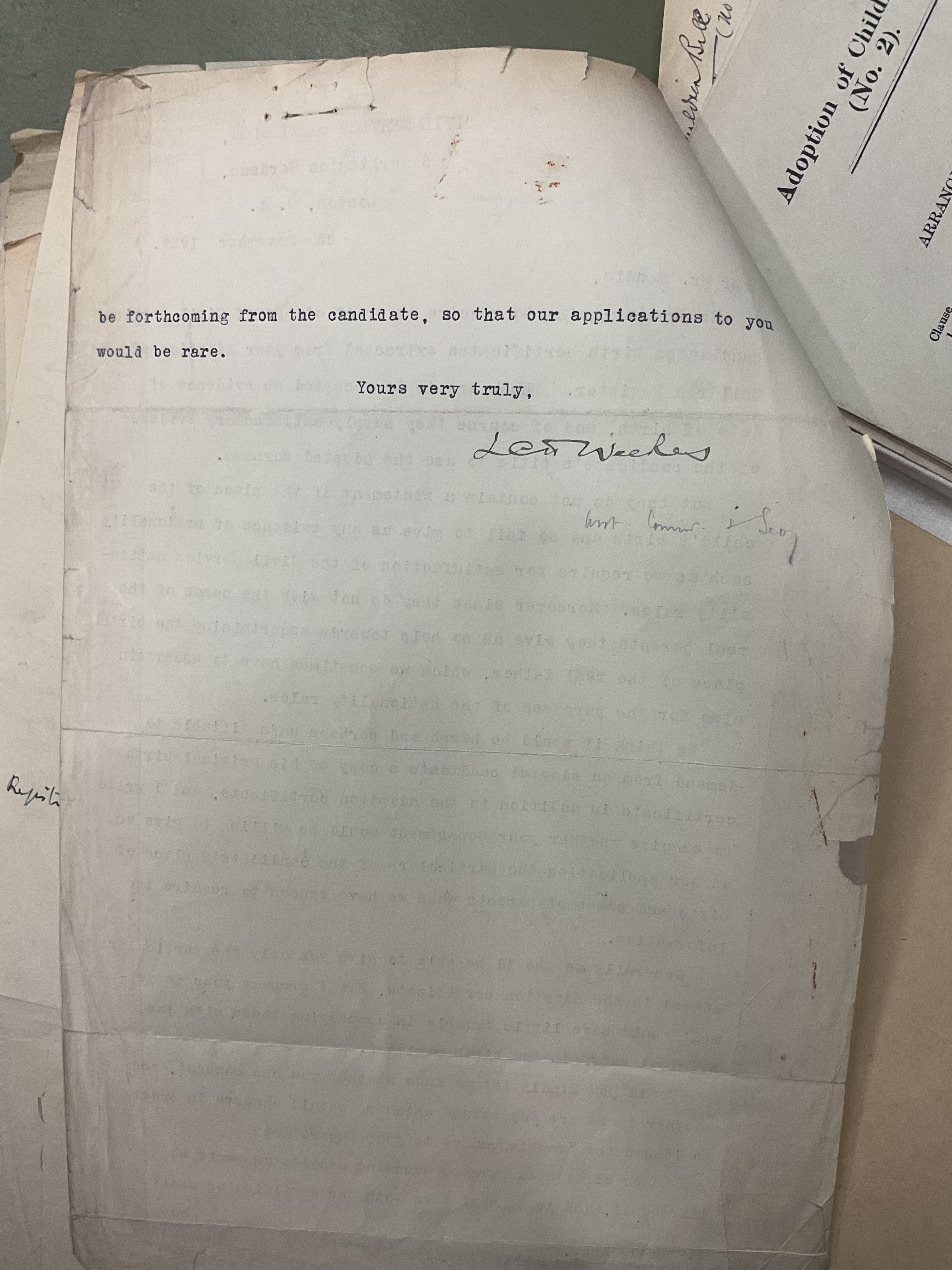
This was all somewhat confusing at first to the Civil Service Commission, who were used to using birth certificates to confirm job applicants were British. Somewhat naïvely, the Assistant Commissioner and Secretary wrote to the General Register Office at Somerset House, asking if they would be able to provide on request details of the adoptee’s birth identity:
We think it would be harsh and perhaps unjustifiable to demand from an adopted candidate a copy of his original birth certificate in addition to the adoption certificate, and I write to enquire whether your Department would be willing to give us, on our application, the particulars of the candidate’s place of birth and names of parents when we have reason to require the information.
Aside from assuming that the adoptee had a copy of their original birth certificate (many were kept from them by adoptive parents, and still can be today while the adoptee is under 18), the Civil Service was requesting information that adoption law hid from public view and from each English or Welsh adoptee. Not until 1975 did the law give rights of access to birth information to these adoptees.
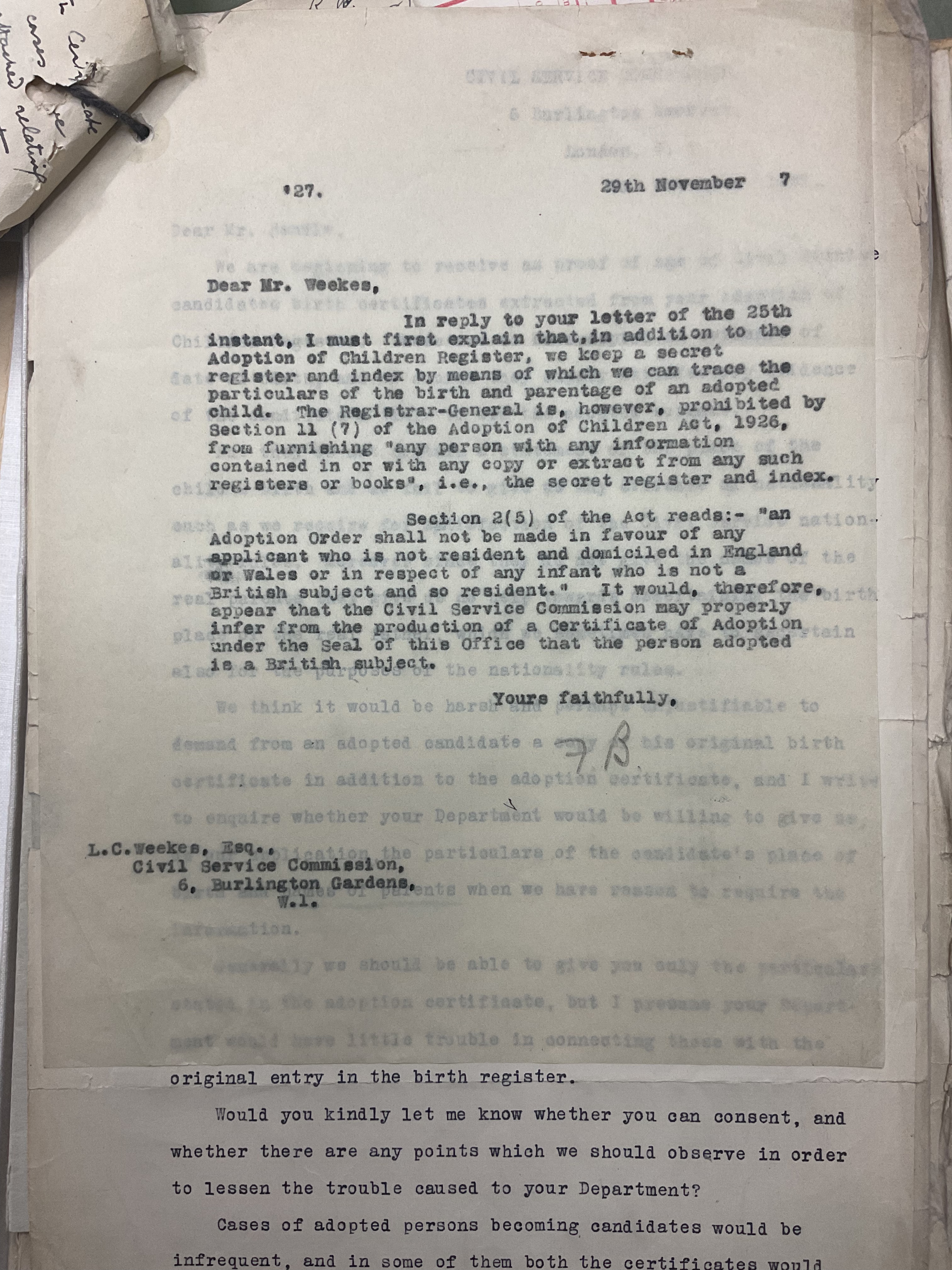
The reply was straightforward: the law prevents us from sharing that information with you, but it also permits only children who are British subjects to be adopted, so you can assume anyone with an adoption certificate is British. They explained their process as follows:
In addition to the Adoption of Children Register, we keep a secret register and index by means of which we can trace the particulars of the birth and parentage of an adopted child. The Registrar-General is, however, prevented…from furnishing “any person with any information contained in or with any copy of or extract from any such registers or books”, i.e. the secret register and index
The legal process of adoption, which today is embedded in our culture and taken for granted, was indeed strange to many and it was difficult to grasp the meaning and the consequences. Adoption societies and others were already hard at work to popularise and normalise it. Today, the particulars linking each adoption with the adoptee’s birth record still sit on the secret register and are only accessible to the adult adoptee or an official intermediary. But let us not forget how abnormal this actually is.
The secrecy and privacy were key to making adoption work and adoption agencies had, from the start, positioned themselves as keepers of the secrets and the buffers between birth family and adopters. From 1949, “shortened” birth certificates were also available. The idea was to provide a copy free or at low cost, on registration of a birth or adoption, as proof that the registration had been completed. The certificates included the legal name, sex assigned, date of birth, and (now) country of birth (place of birth was substituted in 1954), but parents’ name(s) were omitted. Many parents used these as proof of name and birth date for their children, but to adopters there was an additional advantage: the fact of adoption—in theory, at least—was not disclosed. This helped hide the shame and embarrassment of adopted status and thus the stigma of illegitimacy for which many adoptees were bullied (as well as the stigma of infertility for the parents).
The short certificates mislead because the adoptee did not have that name at birth. But for a long time they were issued automatically to adoptive parents once the registration of the adoption order had been completed by the GRO. They helped many adopters conceal the fact they were adopted from their children. The GRO in England have confirmed that they stopped issuing them automatically in 2017 (email dated 5 June 2025) but they are still available for a fee. Adoptees, meanwhile, are stuck with awkward questions such as “Have you ever been known by any other name?” on official forms. And we are taught to lie: even for background checks it is, I’ve been told, fine to say no if my name has not changed since adoption.
These documents are in the National Archives. Ref. RG 48/124 (General Register Office: Registration of Births, Deaths and Marriages: Correspondence and Papers) Bills: Child Adoption Committee Correspondence.

Resources
- adoption legislation (link)
- Births and Deaths Registration Act, 1947 (pdf)
- The Birth Certificate (Shortened Form) Regulations, 1949 (pdf)
- The Foundling Hospital Act, 1953 (pdf)
- The Registration (Births, Still-births, Deaths and Marriages) Consolidated Regulations, 1954 (pdf)
- The Birth Certificate (Shortened Form) Regulations 1968 (pdf)
 Adoption History