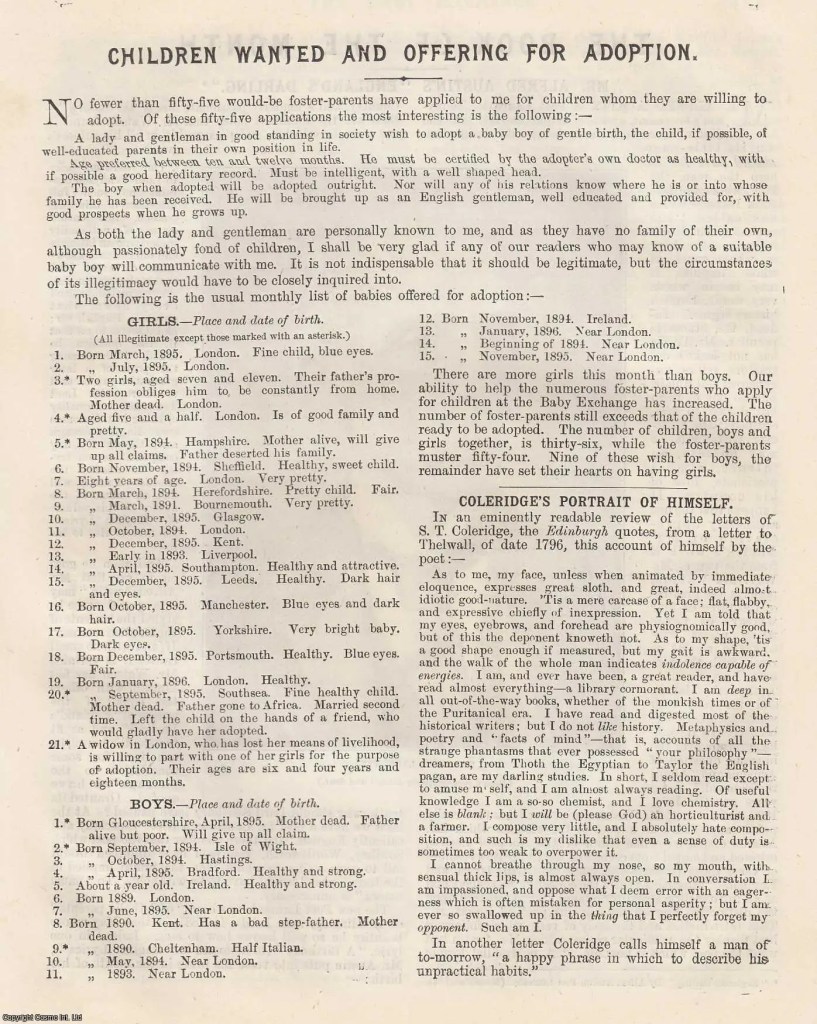
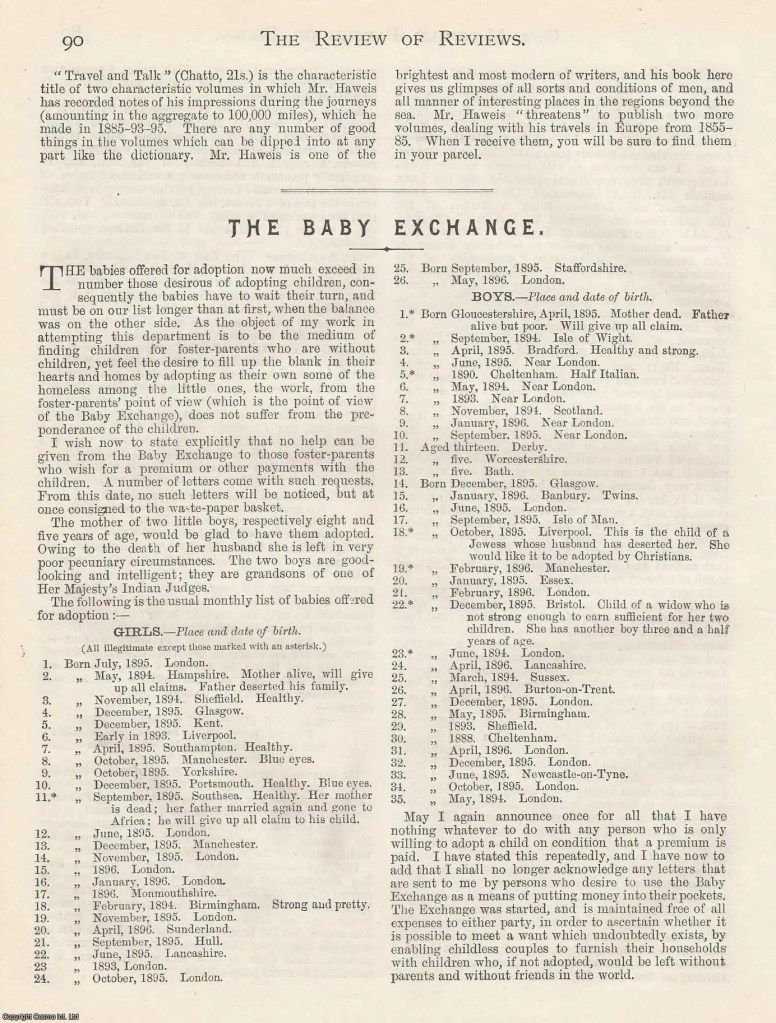
Though short-lived, the Baby Exchange may have been Britain’s first adoption agency. Others were already arranging some adoptions as one stream of work in larger enterprises (most notably, Janet Ransome Wallis at the Hostel of Hope for Homeless Little Ones but also the Church of England Waifs and Strays Society, and the National Children’s Home, among others), but when W.T. Stead proposed a ‘baby exchange’ in his own publication Review of Reviews in June 1895—with a clear statement that children would not be placed or taken for financial reward, and that foster parents must commit to raising the child to adulthood—it certainly resembled adoption, and an adoption society, as we now understand them.1
By taking on the role of broker or agency himself, W.T. Stead was performing the screening or vetting duties that would later be formalised in the role of moral welfare worker, adoption agency worker and adoption social worker. He was effectively a go-between for parental matchmaking, receiving applications by post and listing available babies and children in his monthly magazine. By following him through the process of setting up the Baby Exchange, we can see the reasons and practical considerations for running an adoption agency.
A progressive journalist and social campaigner with an interest in issues affecting women and girls,2 Stead laid out his rationale for expanding adoption as a practice in “Wanted: A Baby!” in the June 1895 issue of Review of Reviews:
The need for having some institution of the kind is undisputed by any one who has had any practical acquaintance with the realities of life. There are families that have too many children, and there are couples who have none. There are homes which have been desolated by bereavement, and there are others that have been almost as desolated by the influx of what may be called supernumerary children. There are families of little ones, which have been deprived by death of their parents, and there are families childless and sad. At present society has provided no medium of exchange that would tend to equalise the supply and demand and redress the balance between those who have too many babies and those who have too few.
[…]
I have long been of the opinion that a much greater extension of the practice of adoption is one of the most obvious methods of alleviating many of the minor miseries of life. How many, I wonder, of those whose eyes will idly fall upon these lines, but feel in their heart an echo of that yearning cry, “Give me children, or I die,” which often springs unbidden from the deep mother-instinct of the lonely, childless or unmarried amongst us. This is not an enterprise which can be carried out at once on any cut and dried plan; but suggestions will be welcome that may tend to supply a practical means for meeting a practical need.3
Note the clear language describing an economy of babies (‘medium of exchange’, ‘supply and demand’), and a focus on the needs and desires of the adopter that is still familiar to us today. Adoption was depicted as a neutral and fair redistribution of assets (children) between adults. Though the methods were similar, the refusal of payments was what distinguished adoption from baby farming. And although no funds were to change hands, there would still be administrative costs and Stead mused in the following issue that these might need to be recouped if the project were successful:
There is another question which is not important at present, but which will certainly come to the front if this business develops—that is, the cost of managing such a Baby Exchange. The mere correspondence between the parties, the arranging of personal interviews, and opportunities of inspecting the babies on either side, will entail an amount of trouble or time that ought to be recognised in some way by those who invoke the intervention of this agency. At present everything is tentative; and I am certainly willing to arrange the preliminaries in the case of the first few babies to be adopted. But the moment the work begins to develop so as to necessitate the creation of a department of its own, with a staff, I should be compelled to charge some registration fee to cover the unavoidable expense. That, however, should not be discussed at present. (Vol. 12, pp. 86-87)
In the same article, Stead also laid out his ‘conditions of transfer’:
First, those who wish to adopt a child must send a letter formally undertaking to adopt a child as their own and engaging to bring it up in all respects as if it had been their child. If the Baby Exchange is to obtain any dimensions this document will have to be very carefully drawn up from a legal point of view, signed, sealed and attested. In the second place, references to two householders of good standing should be given, who will certify that the would-be adopters are in a position to maintain the child and of a character which would justify the expectation that they would rear it lovingly and well. Then, those who have a child will furnish me with a document, duly signed and certified, setting forth what child they have to dispose of, and that they make it over absolutely to those who wish to adopt it, disclaiming all desire and intention of exercising any right to authority which they may have over the child in law. Secondly, a reference to one householder, by preference a minister or magistrate, who would certify to the character for trustworthiness held by those who wish to part with the child. (Vol. 12, p. 86)
These particulars—advertisements, written references, legal contracts, ‘full surrender’ of the child—would remain the basic tools for arranging adoptions for the next three decades, in spite of the fact that legal transfer or relinquishment of parental rights and responsibilities was technically not possible. When major national adoption agencies were established towards the end of World War I, they largely dispensed with advertising and maintained their own lists of available children and prospective adopters. And eventually, in 1926, an adoption law was passed so that these dubious contracts could be replaced with official court-sanctioned adoption orders, and children’s identities could legally be changed.
In his August column, “The Proposed Baby Exchange: A List of Infants Wanted and Offered” Stead quoted from letters received and conceded that matching would not be easy:
These are some of the letters I received, from which it is evident that the Baby Exchange will demand very careful handling. The worst of it is the babies do not fit. I do [not] see exactly how any of those offering exactly meet the requirements of those who are willing to take them. I am willing, however, to let the offers remain over until another month. I have marked the letters in alphabetical order, so that they can be referred to by letter, and correspondents be brought into communication with each other. All those who wish to communicate with me in regard to babies should state—(1) sex, (2) age, (3) the reason why it has to be disposed of. (Vol. 12, p. 179)
The following month, he considered some of the arguments frequently levelled against adoption at the time (that it would somehow both incentivise ‘illegitimacy’ and free unmarried mothers of their obligations):
Great care of course would have to be exercised to prevent the Baby Exchange from reproducing all the evils of the Foundling Asylum [i.e., the Foundling Hospital], so far at least as that institution relieves parents of the responsibility of parentage…Of these thirteen [children who have been offered for adoption], seven are illegitimate. One is sorry for the unfortunate children who, through no fault of their own, are brought into the world in this fashion; but the establishment of an agency by means of which the children of illicit unions can be provided for would tend to weaken one of the deterrents which at present serve to keep down the percentage of illegitimacy. At the same time, the children exist, and the question is, What is to be done with them?…In almost every case the mothers declare they cannot keep them; in some the attempt to do so would land both mother and child into the workhouse, which certainly cannot be regarded as an ideal training place for children. (Vol. 12, p. 266)
In October, Stead announced his first successful placement of a child for adoption, restated the conditions, and requested that applicants send photographs of prospective adopters and of the baby being offered (Vol. 12, p. 377). November’s column brought news that four children had been successfully adopted, and Stead explained why he was “approaching the question of baby exchange…from the point of view of those willing to adopt.” In short, if he were to run it as a service for birth parents, it “would tend to inevitably increase the supply of illegitimate children.” (Vol. 12, p. 468) And in December, he made an appeal for available girls which, for reasons he could not understand, were in far greater demand than boys: “I am at a loss to explain why there is such a premium for girl babies.” (Vol. 12, p. 545)
The Baby Exchange column continued throughout 1896, with listings of available children, and sometimes descriptions of prospective adopters. Numbers of available children rose to match and then exceed those of prospective adopters, but age remained a factor with many adopters preferring children of one to two years to younger infants. Most of the children were ‘illegitimate.’ Finally, in December, a column announced “The Baby Exchange: To Be Discontinued”:
I am sorry to have to announce that next year I shall not continue the Baby Exchange. The risks are too great. I have made an honest attempt to see if it were possible to act as intermediary between the owners of superfluous babies and childless homes. I have proved its possibility, and there can be no doubt as to the urgent need for some such agency. But the sudden and unexpected return of one of the children on my hands, owing to the adopting father, whose character had been vouched for by unimpeachable authorities, falling before temptation and losing his means of livelihood, compelled me to reconsider the position. I have no hospital or institution to serve as temporary resting-place for the inevitable percentage of “returns.” Yet some such home, it becomes more and more evident, is indispensable for the proper working of the Exchange. I have, however, other work to do than founding and managing such an institution. Neither have I any desire to find myself saddled after a while with the sole responsibility for the maintenance and education of unwanted babies whose parents have disappeared, and whose adopted parents, despite all legal undertakings to the contrary, return the adopted child upon my hands.
Hence, although I shall continue from time to time to arrange for the adoption of such children as are already on offer, I shall not in future advertise the Exchange or endeavour to extend its operations. As I have already said, the risk is too great. (Vol. 13, p. 562)
There followed a report “handed me by the lady handling the Exchange” summarising the work done by the Baby Exchange and appealing for “a woman of means, or a few women of means, who would take up this work.” (p. 562) The report also attempted to justify having made the failed placement:
Even the case which opens up the vista of possible difficulties in the future was perfectly bona fide. The foster-mother took the child from pure motherly love. Very likely she thought that if there was a child in the home her husband would be attracted from his gambling; but gambling is such a vice that, when once it lays hold of a man, neither wife nor child can stay the victim in his downward path. The little girl thus unmoored is likely to find a still better home with clients who have been waiting a long time for a child to suit them. (p. 562)
And so the Baby Exchange ended as abruptly as it had begun. As requested by the anonymous “lady” who had been doing the work, the mantle was indeed assumed by “women of means” in years that followed.
- Gill Rossini states that the Baby Exchange was one of many organisations at this time “started and operated by totally untrained individuals, who acted for the best of motives, which may or may not have been in the best interests of the child.” (A History of Adoption in England and Wales 1850—1961, Pen and Sword, 2014, p.65). She does not name any other organisations doing solely adoption work, though the Infants’ Home in Bloomsbury, founded by Jane Dean Main around 1865, had claimed to be set up for the purpose of arranging adoptions (see pages 48-49). Jane Dean Main died in 1879 and the Infants’ Home was no longer in operation by the 1890s when WT Stead started his Baby Exchange. I may write a separate blog about the Infants’ Home—given its location in Great Coram Street I believe it I believe it was intentionally set up near the Foundling Hospital to serve some of the women who were not helped by them. ↩︎
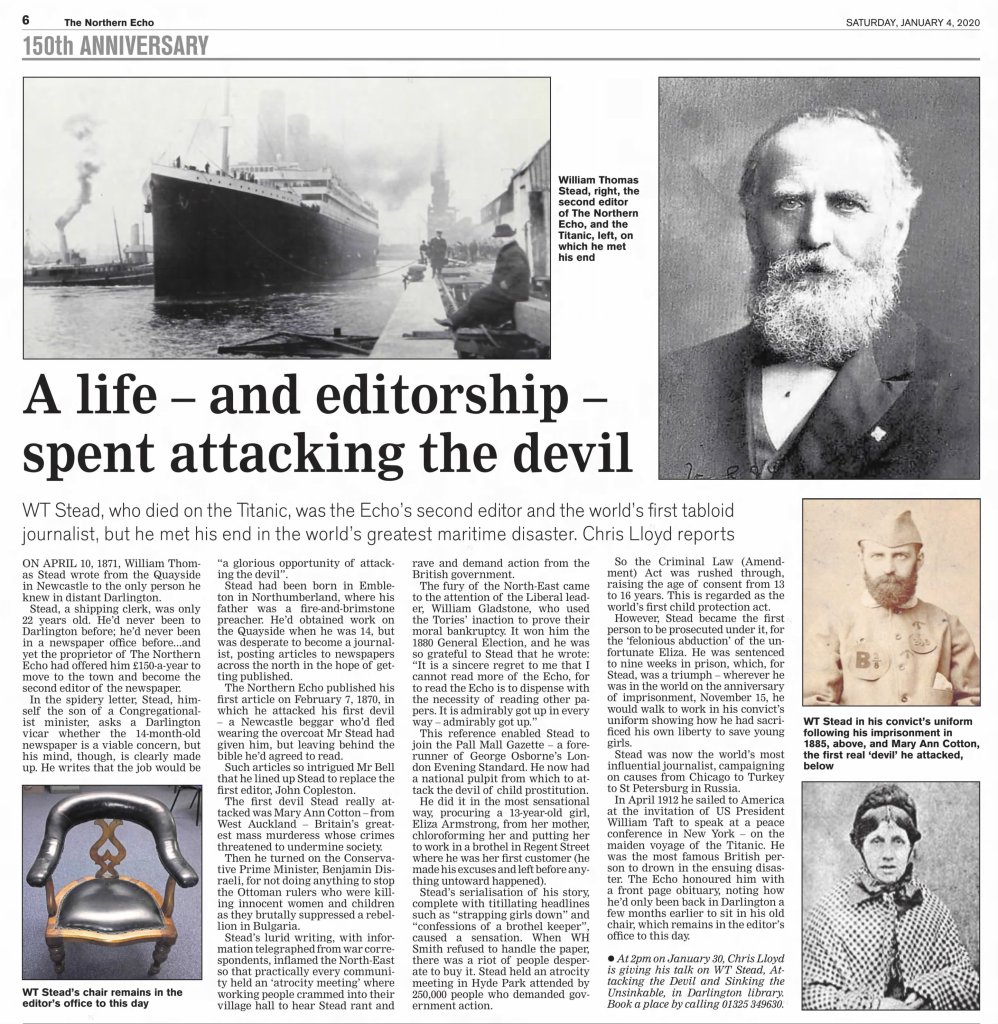
- He was also a Nonconformist and a Spiritualist, served time in prison, and was a victim of the Titanic disaster. There have been several biographies of W.T. Stead, including W. Sydney Robinson’s Muckraker: The Scandalous Life and Times of Britain’s First Investigative Journalist (Robson Press, 2012). There is also a resource site online at https://www.attackingthedevil.co.uk/. ↩︎
- Review of Reviews Vol. 11, p. 561 (June 1895). To read all the issues online (June 1895 to December 1896) visit the following site: https://catalog.hathitrust.org/Record/000507244. Page references for the Baby Exchange are: Vol. 11, p.561; Vol. 12, pages 86, 179, 266, 377, 468, 545; Vol. 13, pages 89, 176, 276, 376, 472, 566; Vol. 14, pages 90, 188, 283, 378, 473, 562. ↩︎
 Adoption History
2 responses to “The Baby Exchange”
A fascinating read. Thank you. Trying to do a service to ‘tidy’ things up seemed a logical way to manage such a situation, yet with the sacred humanity and agency of the child entirely missed. So glad the law stepped in to be able to permanently and legally change their identites (insert eye roll!)
On one level it totally makes sense and on another it is so woefully inadequate and unkind.
How did it then go from women ‘voluntarily’ releasing their children to women being chastised and forced to give them over?
LikeLike
‘Voluntarily’ was always subjective (a lack of options in a capitalist system – having to work/earn money and not being able to afford childcare, or even if able to afford it not wanting to raise a child with the ‘stain of illegitimacy’, means an unplanned baby was a ‘problem’ to deal with) but I think the pressures and cruelty we hear about from survivors who had children removed in the post-war mass adoption era were probably due to (1) high demand ie there were more prospective adopters than available babies (2) how young many of the mothers were and therefore more easily abused and manipulated (3) entitlement – adoption was by now a well established and accepted method for family-building, so some adopters, social workers and healthcare workers felt entitled to take babies from unmarried mothers (4) moralising – pearl-clutching about premarital sex and the idealisation of the nuclear family were at their height in the 1950s and early 1960s
LikeLiked by 1 person