You may have noticed that Adoption UK was publicly calling for (though not actively campaigning for) a UK government apology for ‘historic forced adoption’ and lifelong support for all adoptees. You may also know that they want to diversify their business to provide support for adult adoptees. You may not be aware of how recently they have taken these positions, or of their history and origins.
ADOPTION OF ‘HARD TO PLACE’ CHILDREN
Adoption UK was founded as Parent to Parent Information on Adoption Services (PPIAS) in 1971 by a group of adoptive parents led by Hilary and David Chambers, a white British couple who had consciously chosen transracial adoption to expand their family. They believed that adoption should be made easier, and that more children should be made available for adoption from care or from long-term foster placements. They also wanted to support and advise other adopters and prospective adopters. PPIAS lobbied the government for changes to the law and encouraged local authorities to become members of the Adoption Resource Exchange, a clearinghouse established by the British Adoption Project in the 1960s for local authorities and adoption agencies to share information about Black, Asian and biracial children available for adoption.1
Branches of PPIAS were established in many areas, and by 1977 the organisation had more than 50 local groups. ‘[T]he service is concerned with placing the many children who may be racially mixed, medically handicapped, older than the usual age for adoption, or perhaps brothers and sisters needing placement together. Members of the service include would-be adopters, adoptive parents and interested social workers.’2 The group also acted ‘as a pressure group to try to get children released for adoption’ according to Warwickshire representative Sue Teers.3 Avon local organiser Gita Bremnan told the Bristol Evening Post in 1974: ‘It is becoming harder and harder to adopt. Lists are closed for babies but there is an increasing number of parents who are willing to adopt children who are older, handicapped or coloured.’4 Willing to.
Members received a newsletter ‘which contains pictures and biographies of children awaiting adoption through the Adoption Resource Exchange, a body backing PPIAS’.5 PPIAS also encouraged prospective adopters to create their own ‘foster to adopt’ placement by approaching local authorities and offering to foster a child in care, stating that they preferred a child ‘without parental ties’ who would be available for adoption.6 Later, from 1980, each PPIAS branch chair also held a copy of Be My Parent from BAAF (British Agencies of Adoption and Fostering—the ARE’s successor organisation), a catalogue of available ‘hard to adopt’ children, for prospective adopters to consult. Hopeful adoptive parents then contacted the relevant adoption agency directly. This national distribution of information about available children by PPIAS and BAAF inevitably led to children being adopted transracially to towns and villages where there were no others who looked like them, exacerbating the stigma, discrimination and racial abuse.7
PPIAS also advised adopters interested in acquiring children abroad. Joyce and David Mollet joined the group after going to Bangladesh to adopt their two children. ‘At the moment there is no agency that handles international adoptions in this country, but the PPIAS acts as an information self help group, with many of its members having experience of overseas adoption…Mrs. Mollet has in the last few months been collating information and sometime in the next four years the PPIAS hopes to see an international adoption agency opened in this country.’8
Hilary Chambers and PPIAS were the subject of a Christian Science Monitor syndicated feature in April 1978. The report describes ‘adoption parties’ which PPIAS had been ‘instrumental in starting…They are not markets where children or parents are selected; they are rather fun parties where couples can discover what it’s like to be with mixed-race or handicapped children, and where children can find out what adoptive parents might be like.’9 Another founding member—and chair—of PPIAS was natural mother of two children and adopter of three Sheilagh Crawford, who in 1976 established Parents for Children, an adoption agency specialising in children who were ‘hard to place’ due to illness or disability (and, later, older children too). The agency received a £75,000 launching grant from the Department of Health and Social Security (DHSS).10
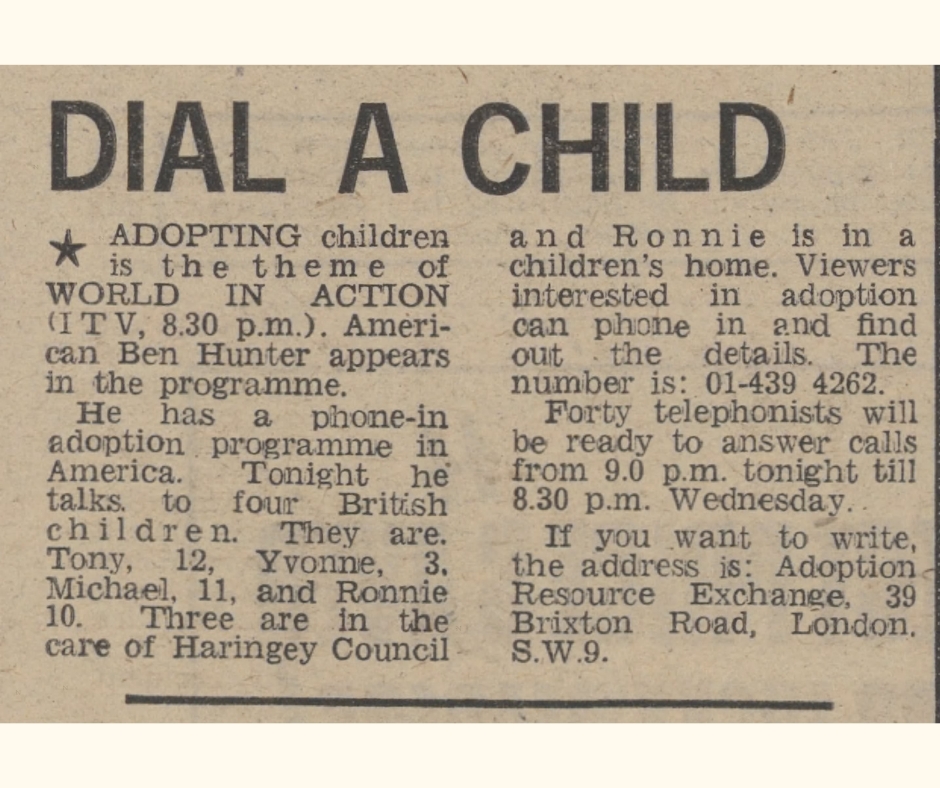
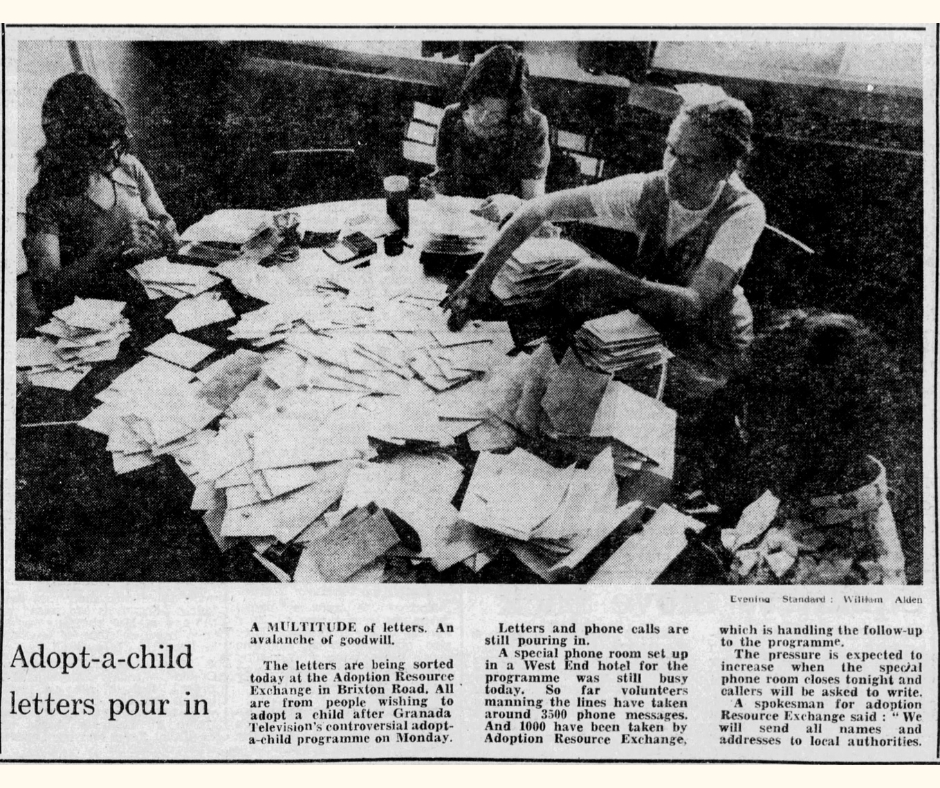
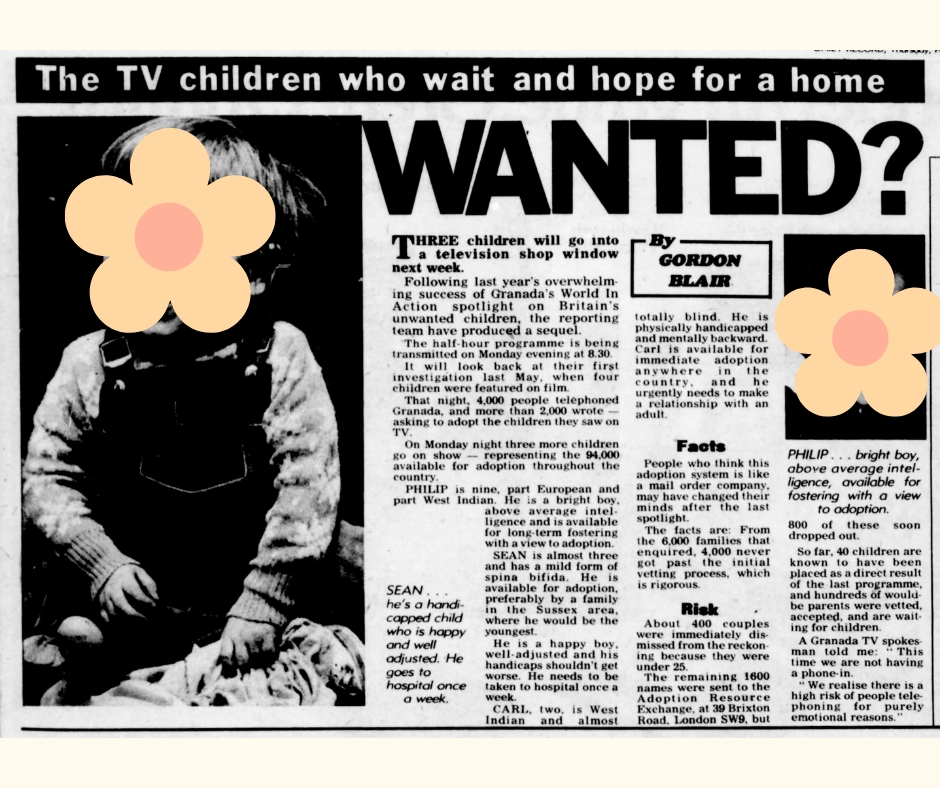
The first Director of Parents for Children, Phyllida Sawbridge—previously Director of the ARE—advocated using media advertising to find homes for available children. During her tenure at the ARE, in 1973 she travelled to the United States to learn how it was done there.11 In May 1974, Granada TV aired a special edition of World In Action featuring four ‘hard to place’ children being offered for adoption. The programme was hosted by American television personality Ben Hunter, who fronted a weekly adoption show in Los Angeles.12 Members of the ARE staffed the 20 phone lines to take calls from prospective adopters. While it was not universally welcomed,13 PPIAS was firmly in favour. Hilary Chambers had defended the programme in advance of its airing and Mrs. Chant of the Kent branch of PPIAS said that members also supported it: ‘Television successfully placed 1,200 children in America. If they can do it there why can’t it work here?’14 The initiative was repeated annually and by 1978 it was reported that 300 children had been placed in this way.15 After running Parents for Children for a decade, Phyllida Sawbridge became the first Director of the Post Adoption Centre (later renamed PAC-UK) when it opened in 1986.
ADOPTION SUPPORT
PPIAS (Adoption UK) never directly arranged adoptions and so did not have to register as an adoption agency; instead they signposted prospective adopters and provided them with information about available children.16 Later, they registered as an Adoption Support Agency and Adoption UK is still among the largest and best known Adoption Support Agencies, operating in each of the UK nations.
It had been recognised that adoption was not always plain sailing and that support might be needed. An early example is the Guild of Service in Edinburgh (Birthlink) which since 1964 had run ‘a series of group meetings for couples who had adopted through us some years ago’ (Annual Report 1964, p.7); in 1967 they had to pause them but hoped to resume in 1968: ‘We have learned through these meetings that it is not enough for a society to arrange adoptions and provide no follow-up after the first few months. Our help is needed over a much longer period than had hitherto been thought, and we must be prepared to take the initiative in offering a service and not leave it to the adopters to approach us.’ (Annual Report 1967, p. 8)
Once they had been given greater responsibility for adoption in the 1970s, some local authorities held support groups, but there was no national funding for post adoption support.17 PPIAS filled a need in providing peer support from volunteers among its membership. It also represented the needs of adopters (and, by extension, adopted children) in policy debate. There were also other charities such as the Post Adoption Centre (based in London and founded in 1986) and After Adoption (based in Manchester and founded in 1990). For adoptive parents and their adopted children, availability of support often depended on local authorities commissioning services from these charities or other specialists, or employing dedicated staff to provide post adoption support.18
By the 1990s too, increasing numbers of adoptive parents were struggling to manage the children they had worked so hard to adopt. Philippa Morrall, national coordinator of PPIAS, told the Independent in July 1994 that ‘People are given very little information, guidance or support by the services when they adopt, and few are told their children might have profound difficulties. Then what so often happens is that the parents become more desperate and alienated from their children because they have tried to be loving and have had it thrown back in their faces.’19 Parents were turning to expensive specialist therapeutic centres in the United States, or a small number of similar services in the UK. These included The Keys Attachment Centre established by adopter of nine Sheila Fearnley in Rawtenstall in 1994. She described attachment disorder as ‘an inability to form ordinary human relationships, which is found in a small proportion of adopted children.’20
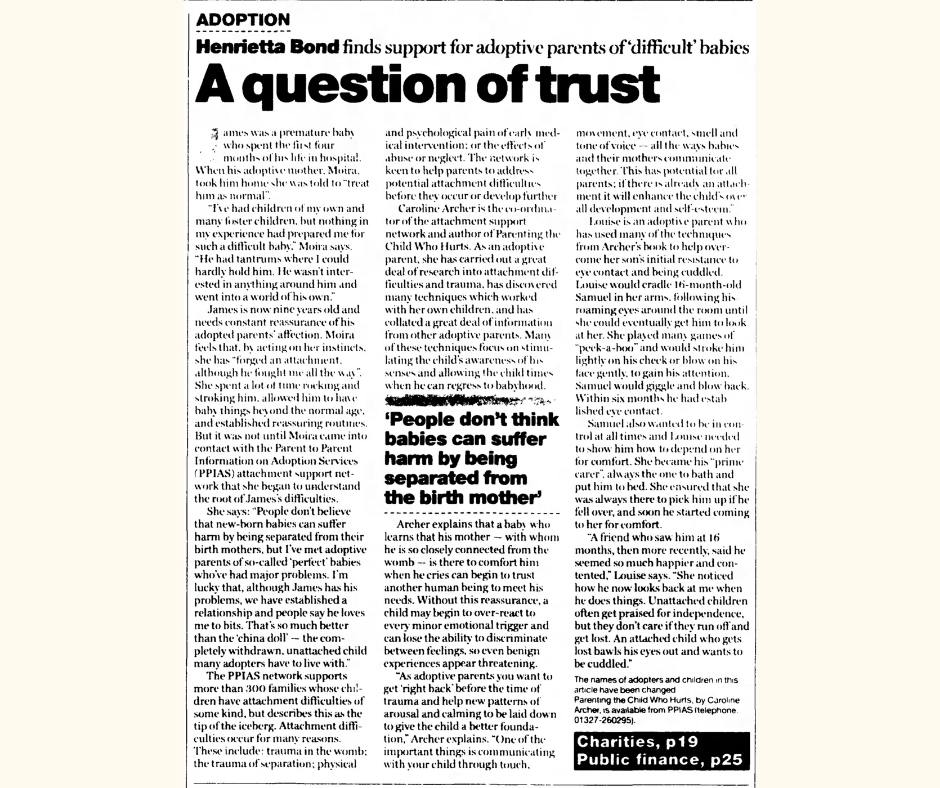
Shelia Fearnley believed that adoptees could suffer from ‘attachment disorder’ regardless of the age at which they were adopted—in contrast to some other professionals who believed that children who had been older at the time of their adoption were more likely to have these emotional difficulties, while infant adoptees were not susceptible (‘blank slates’). PPIAS supported Sheila Fearnley’s view, and published Parenting the Child Who Hurts by Caroline Archer, adopter and coordinator of their Attachment Network Support, a national RAD (Reactive Attachment Disorder) support group.21
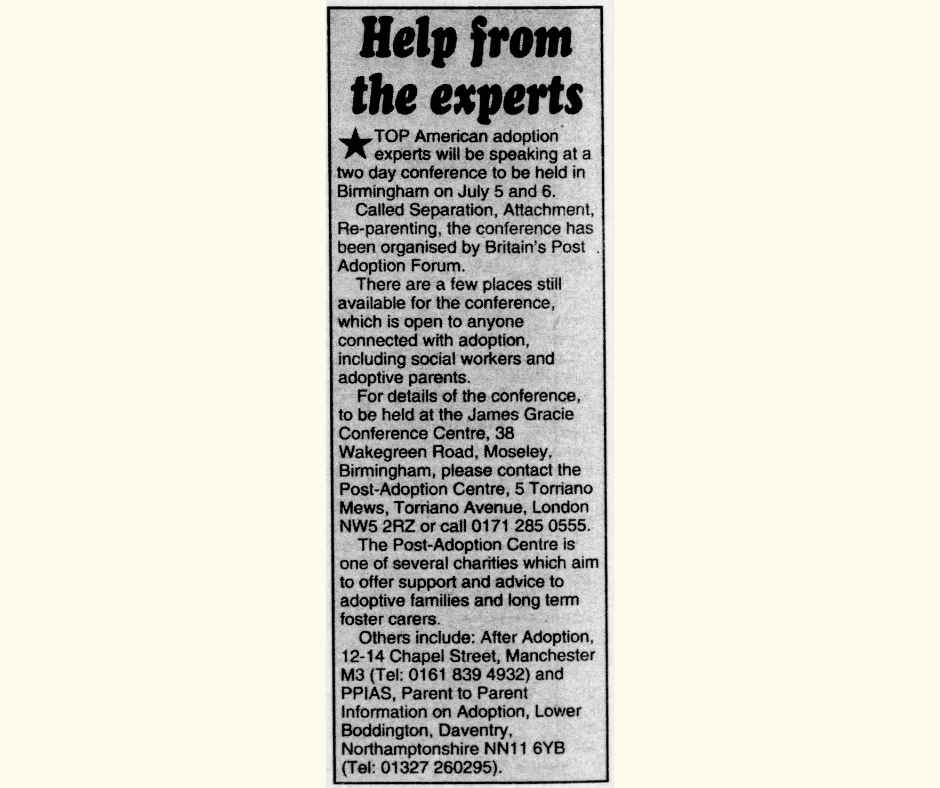
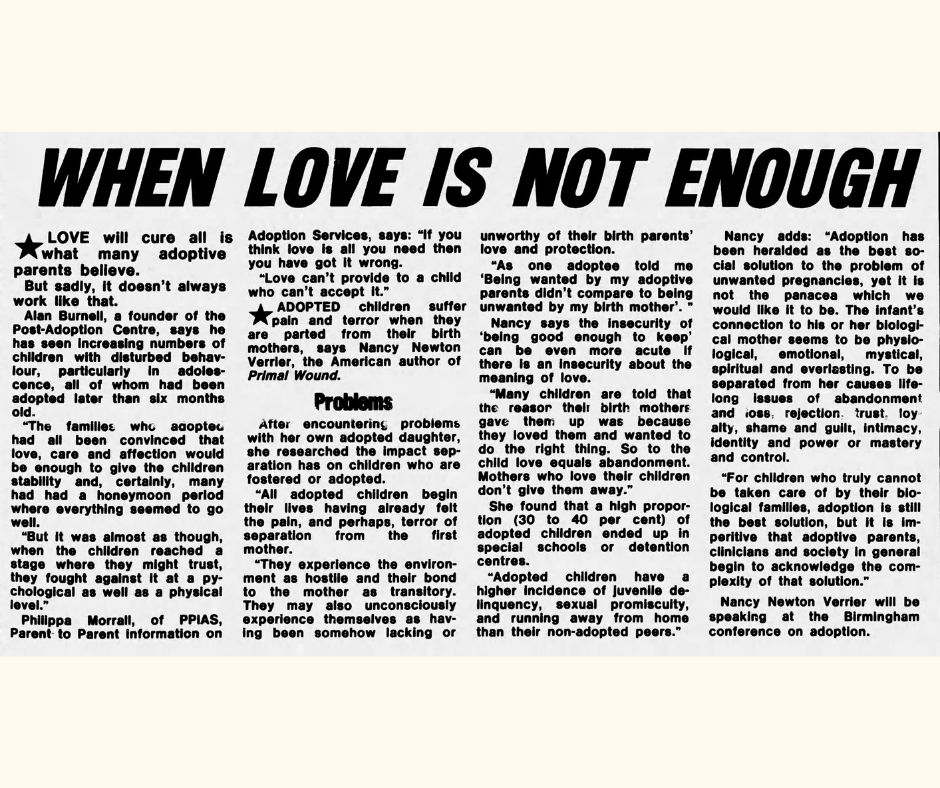
In July 1996 the Post Adoption Forum, a consortium of adoption support charities that included PPIAS, held the ‘Separating, Attachment, Re-Parenting’ conference in Birmingham, featuring guest speaker Nancy Verrier, a US adopter and author of The Primal Wound. In advance of the conference the Birmingham Evening Mail ran a sensationalist spread by Women’s Editor Bryony Jones, featuring first-person accounts from beleaguered adopters and headlines including ‘Bullied and battered by my perfect adopted child’ and ‘When love is not enough.’ Phillipa Morall of PPIAS told the newspaper: ‘If you think love is all you need then you have got it wrong. Love can’t provide to a child who can’t accept it.’22
After securing funding from a three year National Lottery grant, in 1998 the Post Adoption Forum launched Talkadoption, a helpline for supporting ‘adopted people and their families’. PPIAS was now Adoption UK, the name under which it operates today.
21ST CENTURY
These twin themes—promoting adoption, especially of ‘hard to place’ children, and advocating for more adoption support—still form the basis of Adoption UK’s campaigning.23 The bulk of their work is in adoption support and most of their revenue (which totalled over £4m in the 2024/2025 financial year) comes from government grants and public sector contracts.24
Under the Blair government, major reform in adoption—devolved to the national governments since 1999—led to the 2002 Adoption and Children Act, with provisions fully implemented by 2005. Adoptive families were now entitled to an assessment of need and local authorities had to offer adoption support services to all parties but there was not, crucially, a statutory requirement for the support services to be provided to individual families in accordance with their assessments. Further reforms followed under David Cameron’s government, initiated by adoptee and Secretary of State for Education Michael Gove. ‘We need to speed up the adoption process,’ he told Peter Oborne at the 2010 Conservative Party Conference. While Adoption UK welcomed the call to increase the overall numbers of adoptions and speed up some children’s paths to adoption by relaxing the rules about transracial adoption, they were concerned by the prospect of cuts to adoption support as part of cost saving measures. Chief Executive Jonathan Pearce cited the adoption failure or disruption rates—Adoption UK estimated ‘a breakdown rate as high as one in three families adopting children over four’—and he accused many local authorities, whether due to budget constraints or other reasons, of only ‘paying lip service’ to their duty to provide adoption support services.25
Gove was listening. By 2012 he was saying ‘We need to slim down pre adoption assessment, and beef up adoption support.’ In 2015 the Adoption Support Fund (ASF) was launched, giving adoptive parents and adoption support providers in England access to funding for assessments, parenting training, and therapeutic interventions. RAD has been joined by FASD (Fetal Alcohol Syndrome Disorder) and CPV (Child-to-Parent Violence) in the lexicon of pathologies with which to label adoptees.26 The ASF (now the ASGSF—Adoption and Special Guardianship Support Fund) is a major source of funding for support for adoptive families, and of income for providers. When in 2025 its future funding was uncertain, and it was reformed and reduced with further changes planned, organisations representing adopters, kinship carers, adoption agencies and adoption support providers quickly organised to campaign against the changes. Action Against ASFGF Changes (now rebranded as At STAKE) was set up by adoptive parents and brought together a large number of supporter organisations, including Adoption UK. As Adoption UK under Jonathan Pearce had done in 2010, adoptive parents (from such groups as Action Against ASFGF Changes and The Potato Group) publicised their cause by highlighting the high rate of adoption breakdowns and blaming this on lack of support.
It is important to draw attention to this pattern because it illustrates the ingrained thinking of apologists. Adoption is a sacred cow; therefore, if it goes wrong there must be either something wrong with the adoptees (attachment disorders, the effects of early trauma, and so on), or not enough support (which is the fault of government), or both. It is inconceivable that the system of adoption itself could be the problem.
Adoption UK has been campaigning vigorously to protect the ASGSF and to highlight the negative impacts of cuts.
FORCED ADOPTION APOLOGIES
Until 2021—for the first half century of its existence—there is no evidence that Adoption UK was interested in either adult adoptees or mothers who had lost children to adoption. Although mothers had been campaigning for years and there was significant publicity in 2016, including an ITV documentary and an apology from the Catholic Church, Adoption UK does not appear to have commented then.
Following renewed pressure by campaigners, an inquiry by the UK Parliament’s Joint Committee on Human Rights (JCHR) was announced in 2021 and reported in 2022. Sue Armstrong Brown, Adoption UK’s CEO, issued a brief statement on 25 May 2021, saying that apologising to unmarried women who had been forced to give up their babies for adoption in the 1950s, 1960s and 1970s was ‘the right thing for the government to do.’ ‘Thankfully, adoption has changed,’ she continued, ‘…But we owe it to these women and their children to face up to the wrong that was done to them in different times.’ A longer blog (‘Time to say sorry’) was published the following day, in which Sue Armstrong Brown reasoned that the historic wrongs were nothing to do with Adoption UK: ‘Adoption UK was set up in 1971, at a social turning point when the perception of women was changing. The charity was born during the shift to modern day adoption.’27
Adoption UK did not give evidence to the JCHR inquiry. But they may have been involved with the Welsh government’s formal apology for historic forced adoption, which was given in April 2023. In response to the JCHR inquiry report, Adoption UK issued a brief statement from Director of Public Affairs Alison Woodhead on 15th July, 2022. It includes the following:
Today, adoption is rightly a last resort. It offers our most vulnerable children safety, stability and the chance to thrive.
When Deputy Minister for Social Services Julie Morgan gave the apology on behalf of the Welsh government on 25th April 2023 it contained the following statement:
Adoption is now only considered when all other options have been fully explored….[It] provides children with safety, stability, and the opportunity to thrive.
Adoption UK Wales has a contract to deliver adoption support services on behalf of the Welsh government. Given that the apology was about historic adoption, why was it necessary for Julie Morgan to mention contemporary adoption at all? Whose interests are served by being apologists for the current system? It is credible—likely, even—that Adoption UK Wales had a hand in the drafting of the Welsh apology. Not only were they protecting their own interests, they professed full support while failing to consult or listen to those affected, and they ignored the reality: they are active participants in the system that caused the harm.
With this history, should Adoption UK be calling for an apology, or making one?
ADULT ADOPTEES
In April 2021, with the publication of its new three-year business strategy (Empowering Our Community), Adoption UK signalled its intention to diversify its offering to provide support for adult adoptees. One of its goals (p.8) was to ‘co-launch and develop a membership and support offer for adopted adults.’28
In September 2021, Director of Adoption UK Wales Ann Bell conceded that ‘the voices of adopted adults have been too quiet for too long. They have a unique perspective on the adoption system, and sufficient distance and maturity to make sense of what they have experienced. When we listen to adopted adults, one of the things they tell us loud and clear is that the impacts of trauma can last a lifetime. …I think we need to start talking about lifelong support for people who are adopted.’
This followed incoming CEO Emily Frith’s pledge that ‘We are making a strategic shift to put the voices and needs of adopted children and adults more firmly at the heart of the charity’s work. This includes investment in UK-wide programmes for young people and adults, specialist therapeutic support and participation in major new research. This work will all be informed by advisory groups of adopted people.’
In addition to launching a new paid membership for adult adoptees in autumn 2022, Adoption UK also dropped its ‘by adopters for adopters’ tagline and recruited a volunteer advisory group of adult adoptees, on whose expertise it draws to formulate its positions. Some of these positions could be construed as finally listening to adult adoptees, but there seems to be no self-awareness or reflection. Emily Frith told the Education Select Committee at their 2026 hearings on forced adoption that ‘less than a third [of adult adoptees] know where they can access counselling and therapeutic services that are adoptee-competent’:
That barrier [the so-called Ofsted requirement that restricted adult adoptees in England to registered adoption support agencies] has been removed, but now there is very little information available to people on whether a therapist understands adoption…That links to the wider societal understanding of adoption as something positive. To have a therapist who really understands the impact that adoption has had, and continues to have, on your life is really important.29
Here there is no acknowledgement that the ‘societal understanding of adoption as something positive’ has largely been manufactured by adoption agencies and organisations such as Adoption UK over many decades of propaganda. No one ever asked adoptees how they felt, and they are being spoken for by the CEO of an organisation that wants funding to provide support services to them.
This silencing of adult adoptee voices applies in the policy space too. Along with Christian charity Homes for Good, Adoption UK provides the secretariat to the All-Party Parliamentary Group on Adoption and Permanence (APPGAP). According to Adoption UK’s website, it ‘aims to amplify the voices and experiences of adoptees and those in other forms of permanence and their families, to inform parliamentarians and to promote the development and implementation of effective policy and practice.’ Yet the secretariat has rebuffed all requests to put the Adult Adoptee Movement in front of the APPGAP.
While adult adoptees can beat their own path to ministers’ doors, this gatekeeping is indicative of the resistance encountered. And it is one reason why there is little trust of Adoption UK within the adoptee community. Above all, though, many adoptees feel unsafe with an organisation that has institutional amnesia and refuses to admit its own responsibility for the adoption trauma—especially that of transracial and international adoptees, and those with disabilities—that so many live with.
Postscript: A formal apology was given by the Prime Minister on 2 July 2026, this is Adoption UK’s response


- The Adoption Resource Exchange merged with the Association of British Adoption and Fostering Agencies in 1980 to become the British Agencies for Adoption and Fostering (BAAF, now called CoramBAAF). ↩︎
- ‘Adopting a new attitude.’ Scunthorpe Evening Telegraph, 11 June 1977, p.4 ↩︎
- ‘The brave new world of adoption,’ Coventry Evening Telegraph, 26 August 1975, p.3 ↩︎
- ‘Hope on horizon for potential adopters.’ Evening Post (Bristol), 19 November 1974, p.10. ↩︎
- ‘New group fights for action on adoption.’ Tunbridge Wells Courier, 10 May 1975, p.2. The advertising of children to members continued for decades. ‘I was flicking through a copy of Adoption UK and saw a picture of this beautiful little girl,’ adoptive mother Libby told the Rugeley Mercury in 1997. There were 600 initial enquiries from prospective adopters, with Libby and her husband eventually being matched with Serena. ‘Adopting a child can bring very special kind of joy,’ Rugeley Mercury, 13 November 1997, p.6. ↩︎
- ‘One way round the difficulties may be to approach the children’s department with the offer to foster. In this case it is important to state at the first interview that you are interested in a child with no parental ties who would be eligible for adoption. Hilary Chambers has met a lot of people who have used this method of two-stage adoption, which is particularly relevant in the case of older children.’ ‘Finding a home for the melting pot babies.’ Liverpool Daily Post (Merseyside edition), 17 February 1972, p.4 ↩︎
- The use of newsletters and catalogues was a necessity, since only registered adoption agencies and local authorities were allowed to advertise children publicly. Some local authorities did make use of advertising in newspapers. And in 1979, Barnardo’s opened an ‘adoption shop’ in their Colchester town centre premises. Children were to ‘have a say in what is written about them’ and Barnardo’s would receive the ‘agency fee’ of £1,685 for every child placed. The shop was part of the regional New Families Project and ‘based on an experimental advertising scheme launched in Glasgow three years ago’. ‘Dr Barnardo’s to run “adoption shop”’, Daily Telegraph, 8 June 1979, p.19. ↩︎
- ‘Smiles to cheer childless couples.’ Telegraph and Argus, 02 April 1979, p.13. This did not happen as they hoped, and in 1987 PPIAS told the Liverpool Daily Post of intercountry adoption to the UK: ‘It is totally unsatisfactory at the moment. We think the practice should be made illegal, or it should be put on a proper basis with an agency offering real help and support. It should be one, or the other.’ ‘An epic journey to contentment.’ Daily Post, 13 May 1987, p.7 ↩︎
- ‘A helping hand goes out to hard-to-place children.’ Anchorage Daily News, 17 April 1978, p.9 ↩︎
- ‘New adoption agency head,’ Norwich Evening News, 21 May 1976, p.20. Sheilagh Crawford was also organising secretary of pressure group AGRO (Adoption and Guardianship Reform Organisation). AGRO campaigned for changes to the adoption system including to allow mothers to be able to give early and final consent to their babies being adopted. ↩︎
- ‘Screening for mum,’ Guardian, 10 October 1974, p.13. ↩︎
- ‘In America, Ben Hunter once a week brings children in need of adoption on his show. He was brought to England by the “World in Action” team to demonstrate his methods.’ Eastern Daily Press, 14 May 1974, p. 1. ↩︎
- The Eastern Daily Press called it a ‘controversial “child auction” programme’ (14 May 1974, p.1). ‘The programme aroused immediate controversy and its showing was halted until viewed by the Independent Broadcasting Authority, who passed it for screening.’ ↩︎
- ‘New group fights for action on adoption.’ Tunbridge Wells Courier, 10 May 1974, p.2. Hilary Chambers told the Liverpool Daily Post on 27 April (p.1): ‘The needs of the children will be made known to the public, which is quite different from advertising the particular children shown. With careful presentation, the programme is a great idea.’ ↩︎
- Eastern Daily Press, 15 November 1978, p.20. ↩︎
- Both PPIAS and Be My Parent did keep track of placements they had been involved with. ‘Be My Parent have, since 1981, placed 186 children into adoptive homes…PPIAS place 40 per cent of children shown in their magazine in a year.’ Evening Sentinel, 13 April 1984, p.3 ↩︎
- For example, Coventry social services was running a group in 1989. ‘Support groups who ease adoption worries.’ Coventry Evening Telegraph, 4 April 1989, p.10. ↩︎
- ‘Hampshire is one of the few counties in the country which has two posts designated to develop and provide post adoption services.’ Southern Daily Echo, 3 June 1992, p.10. ↩︎
- ‘The children who hate to be loved,’ Independent, 29 July 1994, p.22. ↩︎
- ‘Learning to love,’ Manchester Evening News, 13 September 1996, p.12. ↩︎
- ‘A question of trust,’ Guardian, 04 March 1998, p.53. ‘The PPIAS network supports more than 300 families whose children have attachment difficulties of some kind, but describes this as the tip of the iceberg. Attachment difficulties occur for many reasons. These include: trauma in the womb; the trauma of separation; physical and psychological pain of early medical intervention; or the effects of abuse or neglect. The network is keen to help parents to address potential attachment difficulties before they occur or develop further.’ ↩︎
- Birmingham Evening Mail, 27 June 1995, pp.12-13. ↩︎
- From their annual report in 2017: ‘Adoption UK is a national membership organisation for prospective adopters and adoptive parents and others interested in permanence or children, providing information, advice, support and training, established in 1971…The charitable company’s objectives are set out in its articles as follows:
(i) to advance the education of the public about all aspects of the legal adoption of children; and
(ii) to promote the care and welfare of existing and potential adoptive children with particular regard to such children as have special needs, particularly by facilitating their adoption by suitable persons who are able to meet those needs’ ↩︎ - ‘Total income includes £736,411 from 59 government contract(s) and £3,045,924 from 14 government grant(s).’ The full accounts and annual returns can be viewed on the Charity Commission website or via Companies House. ↩︎
- ‘Cut adrift without support: the anguish of parents who adopt,’ Observer, 7 November 2010, pp.8-9. ↩︎
- One provider, Family Futures, was offering a 10-week NVR (‘Non-violent resistance’—a technique to counter CPV or ‘Child-to-parent violence’) training course for adoptive parents at a cost of £2,500 per parent or £4,000 per couple. Their flyer reads ‘Please promptly contact your local authority and send them this flyer, urging them to apply for ASGSF funding.’ Adoption UK Wales offers NVR training and Adoption UK’s NVR course for Adoption South East has been renamed ‘Managing anger and defiance: practical solutions’ (the January 2026 course was called ‘Non-violent resistance’). ↩︎
- Separately, Adoption UK’s Director of Scotland Fiona Aitken called for an apology from the Scottish government on 18 June. ↩︎
- This was also announced on p.14 of the 2021 Annual Report. ↩︎
- The transcript can be found here. In the same session, Emily Frith also made reference to ‘the societal narrative of adoption being a happy ending’—again, who has encouraged that ‘societal’ narrative? ↩︎
 Adoption History
2 responses to “Who are Adoption UK?”
this
LikeLike
Thank you Vanessa, calling this organisation out for their hypocrisy is long overdue.
LikeLike