In addition to the actual work of arranging adoptions, the [National Children Adoption] Association and its Director have been instrumental in creating a well informed public opinion on matters relating to adoption, and particularly on bringing adoptions within the jurisdiction of the Courts and making the adoptions legal and binding through the Adoption of Children Act, 1926. This measure was very largely the outcome of the activities of members of the Association through whose instrumentality a Bill to legalise adoption was on four occasions introduced into the House of Commons, being finally replaced by the Government Bill; and in particular Your Petitioner, Miss Clara Andrew, took a very great interest in the legalisation of adoptions by Statute, and gave evidence before the Committee on Child Adoption…
NCAA application for a royal charter, 19301
For once they were not exaggerating their importance. Evidence of the efforts made by some members of the Association can be found in government documents and in Hansard. From her initial introduction to Whitehall in early 1918—by Lord Rhondda to senior civil servant H.O. Stutchbury of the Local Government Board—Clara Andrew leveraged her connections to lawmakers and Society. Her Honorary Vice Presidents, honorary officials of the Association and other committee members included at one time no less than six Members of Parliament, two Bishops, and members of the aristocracy. Princess Alice was soon recruited as President, and played an active role in promoting the Association—the house on Campden Hill, Tower Cressy, was handed over to her and Clara Andrew jointly by Emmeline Pankhurst and officially opened by Princess Alice in 1919 as their flagship nursery for children awaiting adoption.2
Clara Andrew called in favours from friends, too. In January 1918, she wrote to H. Stutchbury from a London address ‘℅ Mrs. Alan Burgoyne’ and soon Lt. Col. Alan Burgoyne, MP also wrote to Stuchbury, asking if the NCAA could say they had the support of, and had been promised a grant from, the Local Government Board (the answer was no). Burgoyne, in turn, persuaded (or as she put it, forced) Jean Hamilton, the wife of General Sir Ian Hamilton, to be on the Committee and to attend a March 1919 meeting to establish the London branch of the Association.3
Lady Hamilton had adopted two children, though not from the NCAA.4 She was aware of Tower Cressy when it was run by the Women’s Social and Political Union as a Montessori nursery (with two of the Kenney sisters as teachers) before being handed over to the NCAA. She approved of their educational approach and decided to send her adopted son Harry there. But her charitable interest in children was focused on the Paddington Day Nursery, of which she was President. Jean Hamilton recorded the NCAA meeting in her diary:
In the afternoon I went to a large meeting of the Children’s National Adoption Scheme—Col. Burgoyne has forcibly put me on the committee; it was very interesting, and a poor woman sitting beside me broke out at question time with her grievance that she had an adopted son of 13, who had a bad mother and who had never come near them since he was a baby but now was always molesting him and waylaying him in the streets. The Committee was much bothered by these indiscreet questions, which I kept egging her on to ask, as I can see no way of dealing with this; even if a new law is passed a mother is a mother, and a son is a son, bone of her bone and flesh of her flesh—“God and the soul stand sure” Browning says, but one sometimes wonders about that, but as long as this world lasts Mother and child must stand sure with links no law can really sever. I prefer the way I have acquired my little two, both utterly deserted by their mothers—
“Where did you come from, baby dear?
Out of the everywhere into here.”
I do not want to know their parentage or anything of their parents. Little Harry fascinates me, he develops so much character, and is so gay, sweet and naughty, and the sweetest tentative engaging smile when he is good, McAdie can in no wise resist him, and crawls about the floor at his bidding—it is a sight to see her and Harry crawling on all fours like lightning all about my room after his bath, he expects me to do the same in my best gown, but my knees don’t permit.5
Lady Hamilton also raised money for the Paddington Children’s Hotel, a temporary home for children whose mothers were unable to care for them, but it is not clear that the project ever came to fruition. She resigned as President of the Paddington Day Nursery in 1923 but continued to host fundraising events at her Hyde Park Gardens home. Her association with the National Children Adoption Association, on the other hand, appears to have been short-lived. Lady Hamilton seems to have extricated herself from the NCAA soon after joining, perhaps because she did not owe them any favours—her adopted children were not supplied by them. Or perhaps she did not approve.
The NCAA Chairman, Reginald Nicholson MP, was joined on the Executive Committee by his American wife Natalie (daughter of Frederick Stark Pearson). Before being elected as the MP for Doncaster in 1918, Reginald Nicholson had worked for Lord Northcliffe at the Daily Mirror and then as Manager of The Times. Viscountess Northcliffe was a Vice-President of the NCAA.
NCAA members including the Nicholsons publicised their work by speaking to journalists and supplying photographs of royal visits to their homes and of children awaiting adoption. “We take the greatest care in selecting our children,” Natalie Nicholson told the Daily Mirror in June 1919 at the NCAA offices on Sloane Street, where they had been invited to view baby twin girls awaiting adoption. She showed the journalist paperwork detailing parentage and a full medical history of the babies, which was required before acceptance by the Association.

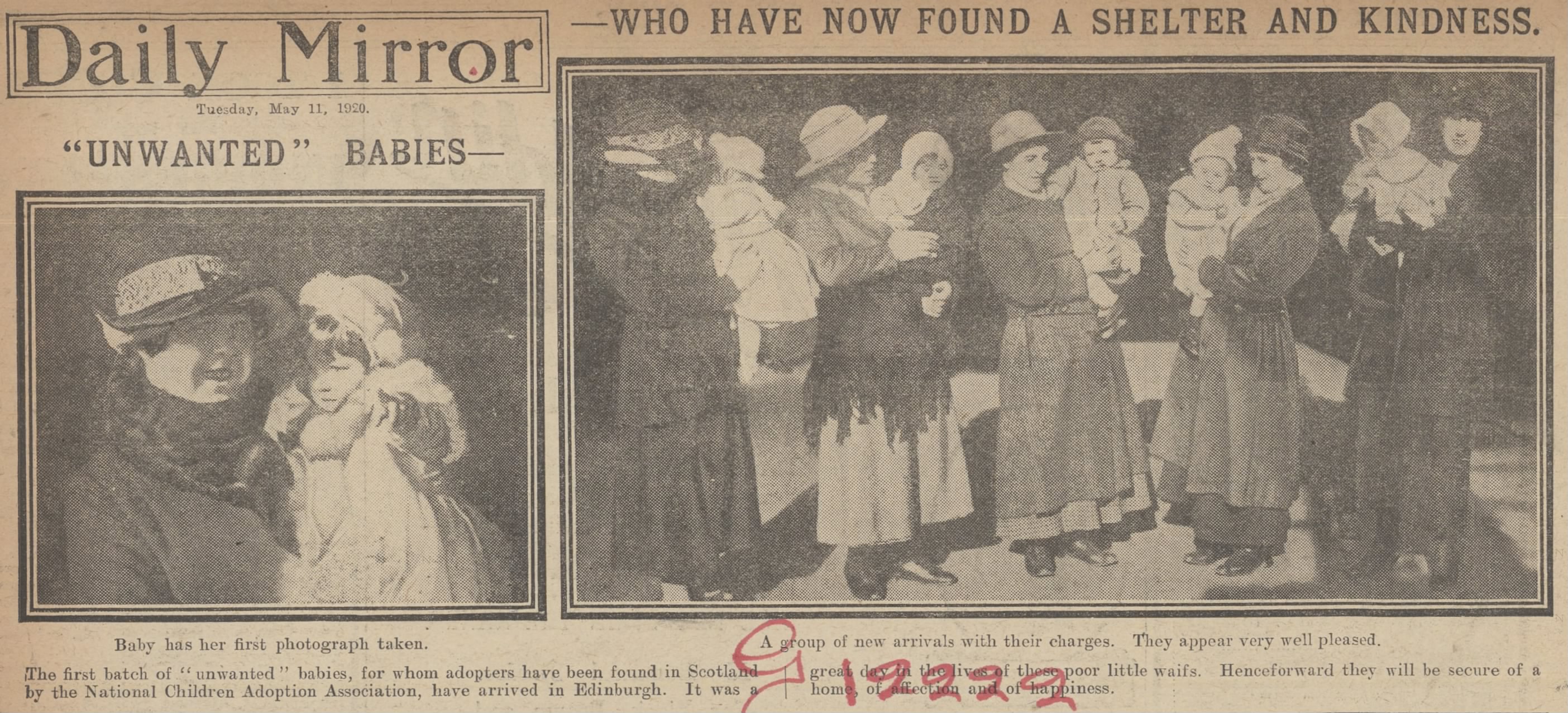
Reginald Nicholson, speaking in March 1920 at a Downing Street reception hosted by Mrs. Lloyd George, to launch a fundraising campaign for the NCAA, told the Daily Mirror “There are thousands of ‘unwanted’ babies crying in the wilderness for help, love and motherly care.” He invited prospective adopters to “Come and choose one.” Later that month, the newspaper published a photograph of the NCAA offices, filled with mothers and foster mothers holding young children who were being offered for adoption. Other photo stories, which ran in popular newspapers or Society magazines, included children being sent to Scotland for adoption, Princess Alice opening a second nursery and training home for nursery nurses in 1921 (also captured on newsreel), and Lady Violet Brassey’s ‘tea dance’ fundraiser at which her own adopted daughter was among the entertainers.


In Parliament, Reginald Nicholson introduced a 1922 private members’ bill to legalise child adoption, supported by Thomas Inskip (NCAA Counsel) and the MP for Exeter Sir Robert Newman (another NCAA Executive Committee member). All three men were also appointed to the Standing Committee for this bill. Inskip also introduced the 1924 Bill, was later appointed Solicitor General (subsequently Attorney General) and spoke at the second reading of the 1925 Bill.
Sir Leonard Brassey (whose wife, Lady Violet Brassey, raised funds for the NCAA and adopted a daughter, Julian) introduced the 1923 Bill (Robert Newman was among the supporters) and supported the 1924 Bill (also supported by Robert Newman—and Oswald Mosley, then Conservative MP for Harrow, whose wife Lady Cynthia Mosley helped Lady Brassey with her NCAA fundraising events and later became a Vice-President of the Association). Leonard Brassey was also a signatory to the 1930 petition for a royal charter and Cynthia Mosley wrote a letter of recommendation.
None of these men discussed their connections to the NCAA in the House of Commons debates. When the final private members’ bill—which would be adopted by the Government and become the Adoption of Children Act—was introduced in 1926 by James Galbraith, he cited statistics provided by the Secretary of the NCAA (Clara Andrew):
When I tell the House that since September, 1917, no less than 2,050 cases of adoption have been arranged and carried out by one society only, namely, the National Children Adoption Association, and when I also tell the House that I am informed by the secretary of that Association that there are no less than 12 of these adoption cases arranged by this society every week, the House will see that the matter is a substantial one, and also an urgent one.
It may have been normal for elected representatives to lobby for and legislate on behalf of voluntary organisations with which they were involved. But the Nicholsons also failed to disclose a deeper personal interest: they themselves were adopters. We only know this because Clara Andrew, appearing before the 1920 Home Office Committee on the adoption of children, used them to make a point that adopters would not stand for inspection by child welfare authorities. “My Chairman and Vice Chairman have adopted children,” she told the Committee, “They both say ‘If anyone came in to inspect my children I should shut the door in his face.’”6
This indicates a desire on the Nicholsons’ part not only for adoption to be legalised but for a particular type of adoption: they wanted the ‘privacy’ of adopters to be protected and for the children to be ‘as if born to’ the adopters. We do not have any proof that Clara Andrew or the NCAA had a part in placing their adoptive children with the Nicholsons, but the dates coincide with their involvement with the Association.
David Benvenuto Nicholson was born—according to the late birth registration made by Reginald Nicholson—on 19 December 1916. Patricia Beata Nicholson was born—according to the record of her baptism on 18 December 1918—on 19 December 1917. Peter Anthony Nicholson was born—according to his adoption certificate—on 05 February 1923. Of these, Peter’s is the only birth date likely to be accurate.
All three children were born before the legalisation of adoption, but the Nicholsons wanted to raise them as their own and as if they were born to them, without disclosing that they were adopted. So what did they do? The law permitted two things: a late birth registration (over 12 months late) provided it was authorised in writing by the Registrar General and signed by the Superintendent Registrar of the district; and an updated birth registration (for example, following baptism), as long as the changes were made within a year of initial registration. For David, the Nicholsons arranged a late registration, and for Patricia they baptised her one day before the date they gave as her first birthday.


There is no evidence that Patricia’s birth was re-registered or updated, but we do not know her original identity so it is not possible to be certain. Similarly, we do not know David’s original identity. It seems unlikely that they had birthdays exactly one year apart and that Patricia was baptised exactly one day before her first birthday (and a few days after her father’s election to Parliament). If they did acquire their children through the NCAA, given the care with which the Association claimed to ascertain the children’s provenance it is also implausible that Reginald and Natalie Nicholson did not know their true identities.
Reginald Nicholson lost his seat in 1922 and did not stand again, but the Nicholsons continued to be involved with the NCAA. Once the 1926 Adoption of Children Act had come into force and adoption was legalised, they applied to the High Court for an adoption order in respect of David, Patricia and Peter. The High Court could grant a single order for more than one child, and this was issued for the three Nicholson children in July 1927. In these early days, many adoptive parents applied to formalise their children’s adoptions through the courts, and so orders were issued for children who had already been in their adoptive households for several years. In these cases, it may be that proper documentation and parental consent were sometimes dispensed with—as indeed they had been when Reginald Nicholson registered David’s birth under his adoptive name in 1921. Or the Nicholsons may have presented original birth certificates for the children to the court—adoption cases were heard in camera, so confidentiality was assured. Tragically, David died in 1937 and his adoptive father registered the death; Patricia lived until 2006 and Peter lived until 2001. We do not know if the Nicholsons ever told their children they were adopted—if they did, no one in the family appears to have ever discussed it publicly.
Child adoption as a form of benevolence must have been very appealing to Society ladies and philanthropists. They could surround themselves with ‘rescued’ children and grateful adopters, many of whom were happy to contribute financially to the cause. Child adoption was presented as a national movement that contributed to the health and vitality of the country, while helping to reduce more exploitative forms of child exchange (‘baby farming’). Upper class ladies could even pick up a child of their own—Lady Violet Brassey, who had given birth to six sons, chose to adopt a daughter and was reported as ‘one of a number of celebrities in Mayfair’ who had adopted.7 The National Children Adoption Association continued to influence national policy, offer stories to the newspapers, and campaign for changes to the law. In the month of Clara Andrew’s death in 1939, a further bill was passed to begin the regulation of adoption societies. Voluntary organisations devoted to, and championing, child adoption are still in existence today.

In spite of their campaigning skills and useful connections, Clara Andrew and her Association did not always get their own way. They never achieved their ambition to become the sole recognised national provider of child adoption, and their application for a royal charter was rejected.
- National Archives PC 12/73 ↩︎
- ‘Awaiting adoption’ was the description given to the children on the 1921 census returns from Tower Cressy and Addison House which had been recently opened nearby (Mrs. Creagh, who had funded the house, took back control from the NCAA the following year). Normally, a child in institutions such as children’s homes would have been labelled as ‘inmate’ on the census. ↩︎
- The National Children Adoption Association had been established in Clara Andrew’s home city, Exeter, by associates of hers there including Mary England, the wife of the headmaster of Exeter School. Mary England wrote to the Local Government Board on Clara Andrew’s behalf in February 1918 to recommend her and the NCAA to them (National Archives, MH 57/53). ↩︎
- Harry Stone (or Knight—neither was his real surname) was abandoned at the Paddington Day Nursery by his mother. Lady Hamilton was involved with the Day Nursery as its President, and eventually adopted the boy. She acquired a second child, a daughter, as an infant via a neighbour, Phyllis Holman—who many years later established the Memorial Centre of Help for Babies in London in 1942, which became the Phyllis Holman Richards Adoption Society in 1969. Phyllis Holman and Clara Andrew were related by marriage. Jean Hamilton was 57 when she adopted her first child. Like other members of the upper class, Lady Hamilton did not raise the children herself, and both Harry and the daughter she named Rosaleen were sent away for extended periods to foster mothers, nurseries and boarding schools. ↩︎
- Lady Hamilton’s diary (typescript entry for 7 March 1919), held in the Hamilton Collection at the King’s College London Archives. Excerpts were published in 2001 by Celia Lee as Jean, Lady Hamilton. 1861-1941. A Soldier’s Wife. Wife of General Sir Ian Hamilton. A Biography From Her Diaries. Helen McAdie was Lady Hamilton’s long-serving ladies’ maid. ↩︎
- National Archives (HO 45/11540) ↩︎
- Evening Herald, 01 January 1926, attributed to ‘People and Their Doings’ in the Daily Mail. ↩︎