Children and Families Minister Josh MacAlister has recently travelled to Denmark to study their children’s social care system with a view to improving England’s. In doing so, he follows in the footsteps of care-experienced journalist Mollie Brandl-Bowen, who campaigned for children’s rights and gave evidence to the Departmental Committee on the Adoption of Children (Houghton Committee) in 1971 [working paper; final report].
Mollie was born in Hastings in 1930 and grew up in foster care. Her mother, Gladys Kathleen Pentecost (b. 1907 in Romney Marsh) named her daughter Mollie Lynn Cowan Fowler.1 At the age of six, Mollie was the object of a tug-of-war battle (sometimes called ‘tug of love’ by the press) between her mother and foster mother, which shaped her views on the adoption and foster care systems. Speaking to the Daily Mirror in 1971, she described the night her mother came to remove her from the home of her foster mother, who had been physically abusive and made Mollie bathe her ulcerated legs. The two women were arguing loudly and as Mollie’s mother dragged her away, she tried to hold on to the gatepost. “Looking back on it now I think my mother was right to take me away because of the cruelty. But it should have been done in a more gentle way.” In spite of all this, she remained attached to the foster mother who, she felt, loved her “in her way” and for many years afterwards would sneak back to visit and bathe her legs.2

Mollie was critical of her mother and some of her foster carers for withholding, ignoring and sometimes denigrating her Jewish heritage. As a teenager she searched for and met her father, Samuel Cohen and was accepted into a Liberal Jewish synagogue; she subsequently wrote for the Jewish Chronicle and became editor of their children’s pages, as well as writing children’s books and being an activist in her Brighton community. These experiences informed Mollie’s insistence that no child should be deprived of, or kept ignorant of, their heritage.
In 1968 Mollie Bowen (now her married name3) was awarded the first Margaret Rhondda Award for research planned by women journalists, for her project to study and write about fostering in Denmark and the Netherlands. She told the Guardian that she ‘wanted foster children protected against the extreme mental cruelty of being taken from their foster homes by their blood mothers before they were old enough to accept the change.’4
An account of her trip was published in the Guardian in September 1968 and Mollie wrote for Mental Health Journal which was published in the Autumn 1969 issue.5 She commented on the ‘progressive attitude’6 in both countries and described children’s homes, fostering (which was ‘treated as a skilled, well-paid job’7) and accommodation with daytime childcare provided for unmarried mothers. Like Josh MacAlister more than half a century later, she observed that children were able to stay in the Danish care system beyond the age of 18, and were encouraged to develop their skills and independence: “The boys stay at the home until they are 22 and learn a trade or finish their schooling. The success rate is very very high indeed.”8
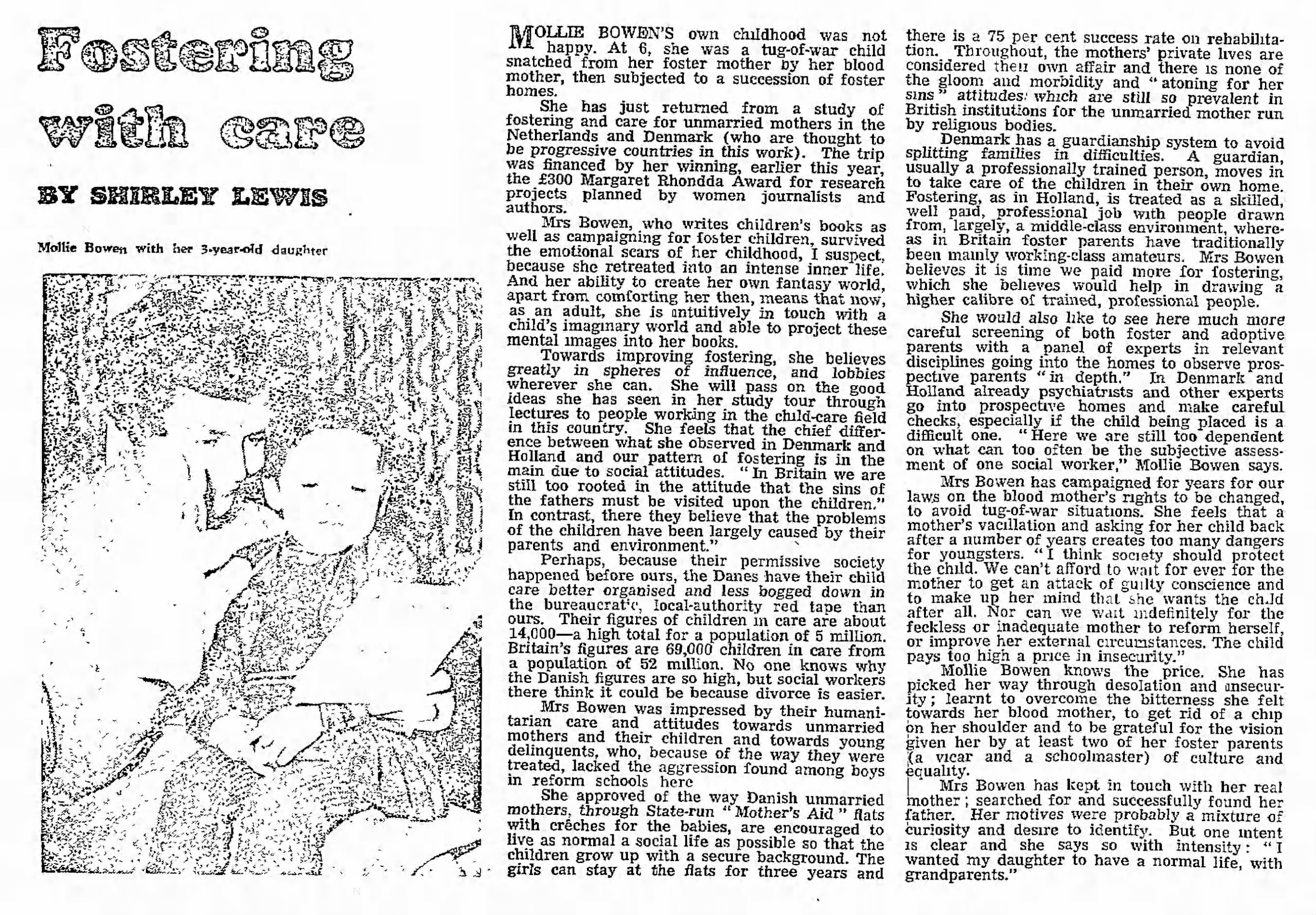
Speaking to the Brighton Argus for a feature on fostering in September 1969, Mollie gave her views on the role of the state:
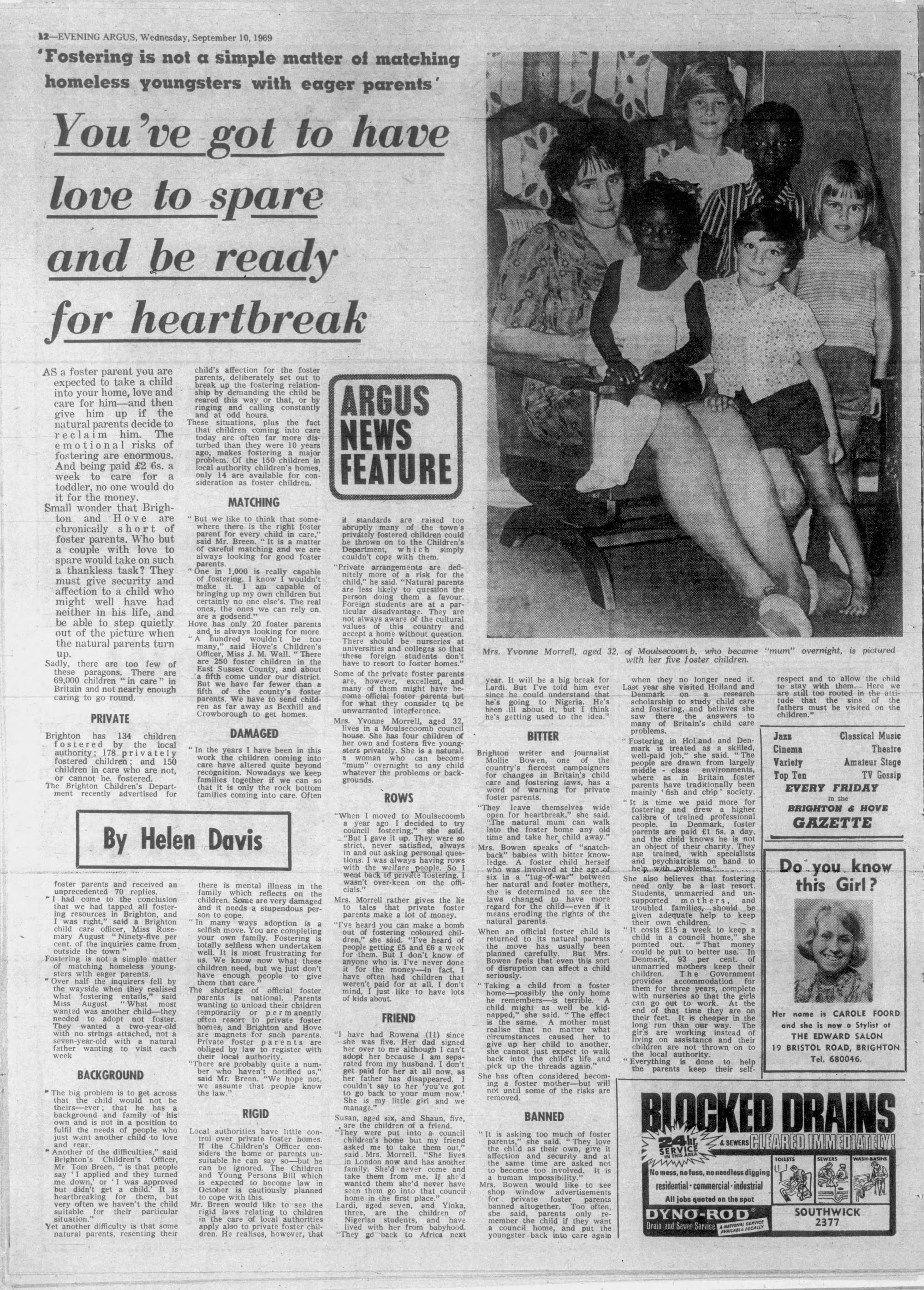
[Mollie Bowen] also believes that fostering need only be a last resort. Students, unmarried and unsupported mothers, and troubled families, should be given adequate help to keep their own children. “It costs £15 a week to keep the child in a council house,” she pointed out. “That money could be put to better use. In Denmark, 93 percent of unmarried mothers keep their children. The Government provides accommodation for them for three years, complete with nurseries so that the girls can get out to work. At the end of that time they are on their feet. It is cheaper than our way. The girls are working instead of on assistance and their children are not thrown on to the local authority. Everything is done to help the parents to keep their self-respect and allow the child to stay with them. Here we are too rooted in the attitude that the sins of the fathers should be visited on the children.”9
Mollie continued her advocacy after the research trip. Spurred to further activism by the case of Jeanette Bartlett, a 9-year-old girl forcibly removed from her Bridport foster home in full view of press photographers in the summer of 1970, she appeared on the BBC TV programme 24 Hours to campaign on the issue. Mollie then joined a delegation to deliver a 40,000-signature petition to the Home Office on behalf of Jeanette’s foster parents. She wanted legal protections against the removal of children from long-term foster placements, even if it meant the weakening of biological parents’ rights, with the interest of the child given priority in such cases.

The Houghton Committee, convened in 1969 to review child adoption, wished to consider these ‘tug-of-love’ cases and floated a proposal for foster parents to be given the right to adopt a child who had been with them for a number of years, regardless of parental consent being granted. Mollie Bowen was familiar to the Home Office since her involvement in the Bartlett case,10 but was not invited to submit evidence. That is, until she challenged committee member Leo Abse, MP on Thames Television’s Tea Break on 4 March, 1971:
MOLLIE BOWEN: Mr Abse, in your committee I would like to ask you one question. Have you any foster children, or adopted children on this committee, and if not, why not?
LEO ABSE: No, but we are taking a great deal of evidence, for example, we have been taking evidence this past week, from foster parents, from adoptive parents, and we are ready to take evidence from people like yourself, because it is very important evidence, when you have taken all the evidence and seen the different points of view, I think you will understand that we are often making a Solomon’s Judgment.
MOLLIE BOWEN: But evidence isn’t sufficient. You see the point is that as I look through this committee here, you must have been through this personal experience before you can really know what it is all about. Because, you know, let me say it, these people are very well qualified, but you do not get a qualification or a degree for being a foster child, or an adopted child or an illegitimate child, but we have one thing which you have not got, and that is the personal experience, and you should have someone with this experience on your committee.
Mollie also objected to the proposal to give foster parents the right to adopt a child after five years in their care. “I foresee here great difficulties because a child might well not want to lose his identity…I certainly would have run a mile had any one of my foster parents suggested adopting me.”
No one with lived experience was appointed to the Committee following this televised dialogue—it had already been working for two years and was made up mainly of professionals including representatives of adoption agencies11—but a few days later Mollie Bowen was invited to submit written evidence and to give oral evidence. Her written evidence made the case forcefully for guardianship over adoption in the case of foster children. For Mollie, adoption ran the risk of taking away a foster child’s agency as well as their identity:
Guardianship I think would be a much more workable proposition—a more humane system, and above all it would retain the basic human rights of the child, namely the right to choose for itself when ready and old enough to do so. I strongly believe that no other person has the right to manipulate another’s life and future, or to choose its parents.[…]
It is too easy to believe all that a foster child says to a Child Care Officer, and I say beware, for foster children want to appear normal and happy, and will often delude the most experienced people. I did this myself and I know others who have done exactly the same thing. It is a fact that foster children are very vulnerable, and often endure untold afflictions, and maltreatment of one sort or another, and remain silent often forever.[…]
Because of the complex nature of fostering, my fear is that maybe the Committee see Adoption as a much easier alternative. It would diminish many problems for those that work in the field. I would like to be assured that this is not so…
At her oral evidence session on 5 April [summary], the Committee discussed with Mollie the proposed right of adoption by foster parents, along with other matters including religion and heritage, putative fathers, and the anonymity of natural parents in the adoption process. They assured her that, in spite of their title and remit, they favoured guardianship over adoption but did not provide any further explanation or details to support this claim.
Mollie continued to campaign for the rights of foster children, featuring in the Daily Mirror on 5th August that year, where she told more of her story. The Houghton Committee’s report was published in 1972. They had modified their proposals from the interim report (working paper), but still recommended that foster parents who had cared for a child for five years or more should be given the right to apply for adoption, with the child to remain in their custody until the court had made a decision on the application.12 The resulting legislation (1975 Children Act and the 1976 Adoption Act) did not give foster parents the right to automatically adopt a child in their care; it did, however, grant the protection against removal pending an application made after 5 years as recommended by the Committee, and provide more scope to dispense with parental consent if it was deemed to ‘promote the welfare of the child throughout his childhood’. In contested cases, it became more likely that a court would decide that consent had been ‘unreasonably withheld’ and to rule in favour of an adoption order.13 Adults were still (and are still) making determinations about the ‘welfare of the child’ for their whole life, but we can thank Mollie Bowen for being a vigorous champion of lived experience in shaping the children’s care system, as we continue to fight for our voices to be included in policy-making discussions. And perhaps we can finally learn something from Denmark?
- Mollie’s mother was adopted: she was baptised Gladys Kathleen Fowler Pentecost in 1908 and in 1911 was living with married couple Lewis and Mary Ann Fowler as a ‘visitor’, then in 1921 is recorded as ‘Gladys K. Fowler, adopted daughter’. This—baptising a child to add an additional name, then eventually dropping the original surname—was a common method of effecting an ‘adoption’ in the decades before it was legalised. As the adoption placement was local to her birthplace, it was probably arranged privately (agents would send a child away from their birthplace) and possibly to a family member or someone else known to Gladys’ mother. By 1939 Gladys had left her adoptive parents and was living in a boarding house in Hastings, working as a ‘daily help.’ This profile by Cecily Woolf (p.17) describes Mollie as ‘half Sephardi and half Ashkenazi’ but there is no evidence that her mother was Jewish. ↩︎
- Daily Mirror, 5 August 1971, p.22. Speaking to the Daily Sketch in 1967 (28 August, p.6) Mollie had described her emotions that evening and the lasting impact on her: “I shall never forget the agony and confusion I felt. I was sure that my foster mother was my real mother, and when I was literally torn away as I clung desperately to her, the final wrench was like being torn in two….For years I felt like a fish out of water. I didn’t belong to anybody. I was a very frightened person for a very long time. That lasted almost until I married. Even now, I hate change or moving.” These descriptions are reminiscent of first-person accounts by earlier lived-experience advocate Hannah Brown, who grew up in the Foundling Hospital system and whose memoir, The Child She Bare, was published in 1919. ↩︎
- In 1955 Mollie married Kenneth Maxwell; in 1965 she married Phillip Eugene Bowen and gave birth to daughter Sarah Eugena Bowen in 1966. It is not clear when Mollie added ‘Brandl’ to her name, or why (she was already using it at the time of her evidence in 1971); her death in 2000 is registered under both Brandl Bowen and Cohen Bowen. ↩︎
- Newspaper clipping dated 20 July, 1968 in the National Archives, BN 29/2329. ↩︎
- Photocopies of both articles are in the Home Office file in the National Archives (BN 29/2329), along with the written evidence, a summary of the oral evidence, and a transcript of her appearance on ‘Tea Break’ on 4th March 1971, where she was interviewed along with Leo Abse. ↩︎
- The Argus, 28 August 1968, p.15 ↩︎
- Evening Argus, 10 September 1969, p.12 ↩︎
- The Argus, 28 August 1968, p.15 ↩︎
- Evening Argus, 10 September 1969, p.12. In the Guardian interview (11 September 1968, p.7), Mollie commented that “The girls can stay at the flats for up to three years and there is a 75 per cent success rate on rehabilitation. Throughout, the mothers’ private lives are considered their own affair and there is none of the gloom and morbidity and ‘atoning for her sins’ attitudes which are still so prevalent in British institutions for the unmarried mother run by religious bodies.” ↩︎
- Miss Peck, who had been among the civil servants meeting the petition delegation, and was also part of the Committee secretariat, recommended her via this handwritten note the following day: “Mrs. Mollie Bowen was a member of the deputation about the Dorset foster child. Although a trifle neurotic—no doubt as a result of being a tug-of-war child—she could be quite useful and I think we should add her name to the list of those to be sent a copy of the working paper and asked for comments in writing in the first instance.” ↩︎
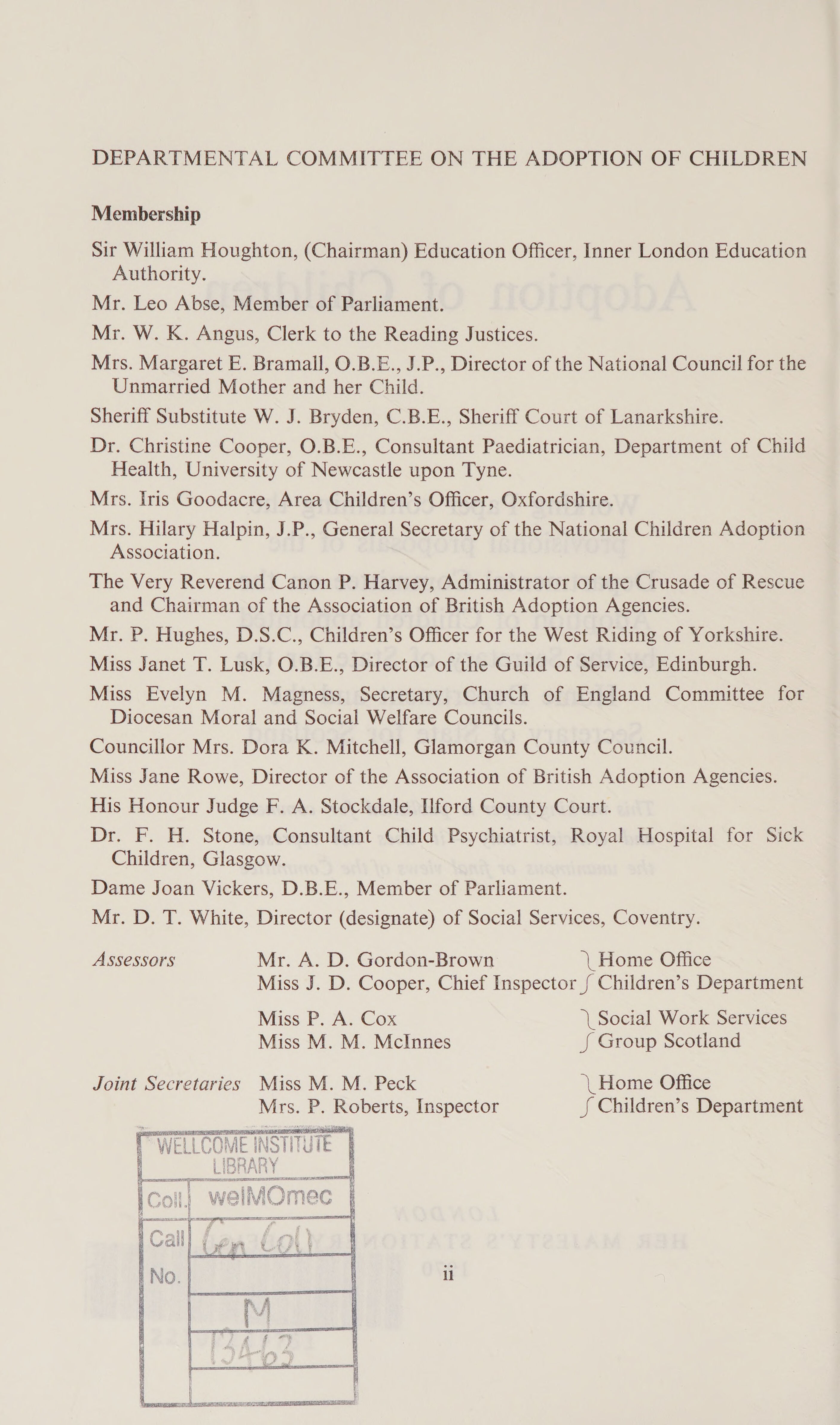
- See list of members on page ii of the Working Paper (image). ↩︎
- See Christine Davies, “The Departmental Committee on the Adoption of Children and the Tug of War Cases,” Modern Law Review, 36.1 (May 1973), p.258. Accessed 01 Nov 2026 via https://www.jstor.org/stable/1093705 [link to full article here]. ↩︎
- This trend had been underway throughout the postwar period, as shown by Emma Melody Bradley, “Blood parenthood and the hierarchy of dispossession in English adoption cases, 1946-1970,” Modern British History 37.1 (2026), accessed 4 Nov 1926 at https://academic.oup.com/tcbh/article/37/1/hwag022/8698722. The Rudd Programme (University of Cambridge, led by Professor Gordon Harold) evidence to the Joint Committee on Human Rights inquiry in 2021 couches the Houghton-led changes in somewhat different terms: “It was not until the Houghton Committee of 1972 and the ensuing 1976 Adoption Act that adoption began to be seen more as part of a wider child protection system, catering also for children who had been abused or neglected in their biological family and had been taken into public care. In light of this, the 1976 Adoption Act introduced a stronger recognition of the power of courts to dispense with parental consent to adoption where there had been harm suffered by the child.” Section 6.2 https://www.educ.cam.ac.uk/centres/rudd/publications/PDFs/Rudd%20Programme%20Adoption%20Enquiry%20Submission%202021.pdf ↩︎